
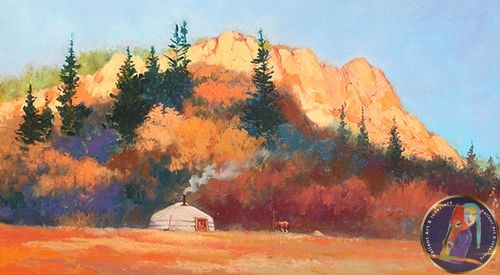
“Alone” is a compelling exercise in photorealism and emotional atmosphere, hallmarks of Olzbaatar Tserendorj’s Moscow-trained technique. Despite its modest horizontal dimensions ($30 \times 50 \text{ cm}$), the work conveys a vast sense of psychological depth and physical space. The composition focuses on the singular presence of a subject—whether a figure, an animal, or a solitary element of the Mongolian landscape—rendered with the meticulous precision of the Surikov Painting Academy tradition.
Color Palette and Light
The palette is likely dominated by the earthy, nuanced tones characteristic of the artist’s realism:
Muted Neutrals: Soft ochres, deep umbers, and cool greys define the environment, creating a sober and contemplative mood.
Chiaroscuro Influence: Tserendorj utilizes sophisticated light play, where a single light source often highlights the textures of the subject—the weave of fabric, the grain of wood, or the softness of skin—against a shadowed or minimalist background.
Atmospheric Depth: The light isn’t merely functional; it feels heavy, as if filtered through the dust or the crisp air of the Mongolian steppe, emphasizing the theme of solitude.
Composition and Style
The artist’s background in Figurative Realism is evident in the anatomical or structural accuracy of the subject.
Spatial Balance: The horizontal orientation ($30 \times 50 \text{ cm}$) allows for a “cinematic” feel, often placing the subject off-center to emphasize the surrounding emptiness. This “negative space” serves as a visual metaphor for the title, “Alone.”
Texture and Detail: Every brushstroke is disciplined. In keeping with the Photorealist style, the artist captures minute details—such as fine lines or subtle reflections—that might be missed by the naked eye, grounding the evocative subject in a tangible, believable reality.