
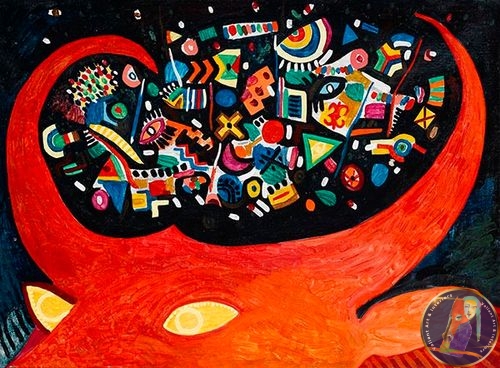
Oilan Janatkhan’s “Composition Head” (2006) is a compelling synthesis of raw expressionism and modern abstraction. Executed in oil on a 61 x 81cm canvas, the work bridges the gap between traditional portraiture and the chaotic energy of contemporary life.
Visual Composition and Form
True to the artist’s Mongonlian roots and his evolution through the 1990s European exhibition circuit, the painting does not offer a literal representation of a face. Instead, it presents a deconstructed anatomy. The “Head” is reimagined as a series of intersecting planes and aggressive textures.
Structure: The central focus is a dense, architectural arrangement of shapes that suggest the cranium, jawline, and features without strictly defining them. This “Composition” feels less like a person and more like a psychological map.
The Palette: Janatkhan utilizes the depth of oil paint to create a high-contrast environment. Expect a sophisticated interplay of earthy tones—reminiscent of the Mongolian landscape—clashing against sharp, modern highlights that give the work an “Expressionist” urgency.
Style and Technique
The painting serves as a testament to Janatkhan’s formal training at the Institute of Fine Art (1987-1991), blended with the experimental freedom seen in his early international exhibitions.
Brushwork: The application is tactile and layered. Heavy impasto sections likely create physical depth on the canvas, catching the light and emphasizing the “Modern/Contemporary” label. Each stroke feels deliberate yet frantic, capturing a sense of movement within a static portrait.
The Hybrid Approach: While categorized under “Portrait,” the piece leans heavily into “Still Life” and “Abstract” territories. It treats the human head as an object to be disassembled and studied, much like a collection of items on a table, stripping away individuality to reach a universal emotional state.
Cultural and Artistic Context
Created in 2006, over a decade after his tours through Pakistan, France, and Germany, “Composition Head” reflects a mature artist who has absorbed the global avant-garde.
Artistic Significance: The work captures the tension between the artist’s nomadic heritage and the rigid structures of Western modernism. The 61 x 81cm dimensions provide a wide, landscape-oriented field for a subject that is usually vertical, forcing the “Head” to compete with the surrounding negative space and creating a sense of monumental scale despite its modest size.