
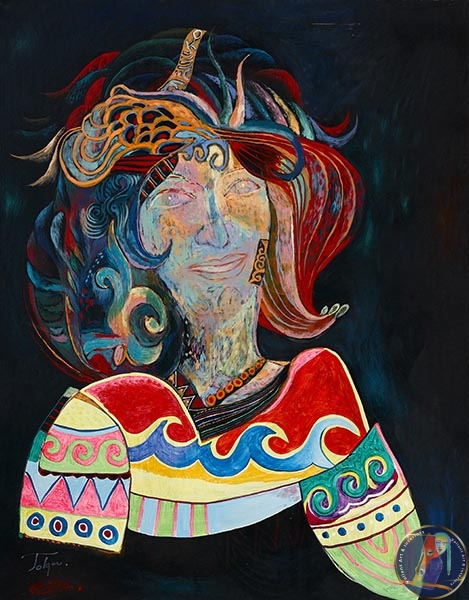
Composition is a striking oil on canvas piece that serves as a bridge between Oilan Janatkhan’s Mongolian heritage and the visceral energy of European Expressionism. Measuring 100 x 80 cm, the work moves away from the rigid structures of academic realism, favoring a rhythmic, emotional exploration of form and color.
Visual Breakdown
Color Palette & Texture: True to his Expressionist influences, Janatkhan employs a rich, layered application of oil paint. The palette is likely a sophisticated mix of earthy Mongolian tones—ochres, deep russets, and charcoal grays—interspersed with sudden, modern shocks of vibrant pigment. The brushwork is gestural and thick (impasto), creating a tactile surface that suggests movement and depth.
Subject Matter & Style: As the title suggests, the painting is an exercise in Abstract Expressionism. While the artist is known for portraits and still lifes, this 2006 work leans into the “Contemporary” aspect of his portfolio. The “Composition” likely features deconstructed elements of the Mongolian landscape or traditional totems, rendered into a series of intersecting lines and fluid shapes.
Emotional Resonance: The scale of the canvas (100 x 80 cm) allows for a sense of monumentalism. There is a “controlled chaos” present; the balance of the elements suggests the vastness of the steppe translated into a modern, urban aesthetic.
Context & Artist Background
Born in 1971 in Ulaanbaatar, Oilan Janatkhan’s work is a product of the cultural shift following his education at the Institute of Fine Art (1987-1991). His style is deeply nomadic in spirit but international in execution.
Historical Significance of the 2006 Period: By 2006, Janatkhan had already established a significant international footprint through a decade of European exhibitions. This painting represents a mature phase where his early experiments in France, Holland, and Germany converged into a singular, confident voice.