
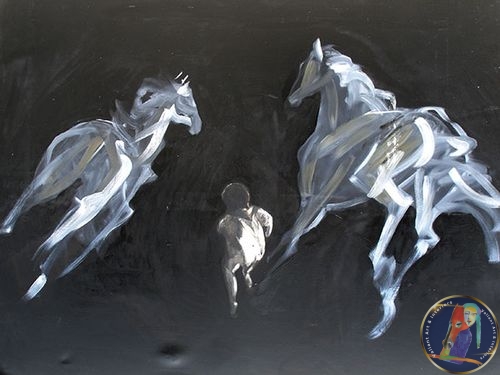
Kharanhui (a Mongolian term typically translating to “darkness” or “obscurity”) is a compelling oil-on-canvas work by Ulaanbaatar-born artist Odgerel Tsulbaatar. Created in 2007, just two years after the artist’s graduation from Fine Art University, the piece stands as a significant representation of contemporary Mongolian art, measuring a substantial 130 x 100 cm.
Visual Composition and Style
The painting is a masterclass in the fusion of figurative portraiture and modern abstraction. Tsulbaatar utilizes the large vertical format to present a deep, atmospheric exploration of mood and shadow.
The Palette: True to its title, the work leans heavily into a somber, sophisticated color scheme. Deep ochres, muted earth tones, and varying gradients of black and charcoal dominate the canvas. These are often punctuated by subtle glazes of light that emerge from the darkness, creating a chiaroscuro effect that feels both classical and distinctly modern.
The Subject: The central focus is a figurative element—likely a human form or face—that appears to be emerging from or receding into a textured void. The application of oil paint is likely layered, moving between smooth, blended transitions and more aggressive, contemporary brushwork that emphasizes the physical reality of the canvas.
Aesthetic Balance: While the artist’s training is evident in the anatomical grounding of the figure, the “Modern” and “Abstract” labels come to life in how the background dissolves. There is no clear sense of horizon or room; the figure exists in an emotional space rather than a physical one.
Artistic Context and Significance
Born in 1981, Tsulbaatar belongs to a generation of Mongolian artists who reached maturity after the country’s transition to a market economy, allowing for a freer blend of traditional Mongolian motifs and international contemporary styles.
Emotional Depth: Kharanhui reflects the “Seeking the Real Feel” philosophy noted in the artist’s 2006 exhibition. It moves away from purely decorative art to explore the internal psyche.
Technical Maturation: Following his 2005 graduation, this 2007 work demonstrates a shift from student-led joint exhibitions toward a refined, singular voice that would eventually secure his place in major Ulaanbaatar showcases like the “Great Mongol 800.”