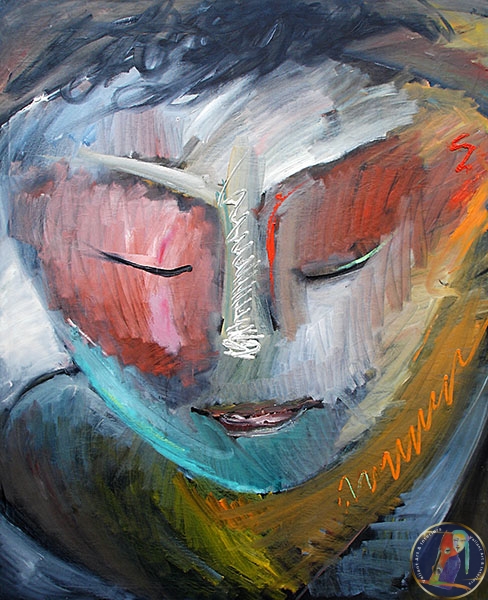
Setgel

Odgerel Tsulbaatar , 2007 , Oil On Canvas

The title “Setgel” translates from Mongolian as “Heart,” “Soul,” or “Mind,” suggesting a deeply internal, psychological focus. Created during a prolific period following Tsulbaatar’s graduation from the Fine Art University, this piece exemplifies his blend of Contemporary Figurative work with Abstract undercurrents.

Visual Composition and Style

The painting is a large-scale oil on canvas (120 x 100cm), a vertical orientation that favors the artist’s background in Portraiture. Tsulbaatar employs a sophisticated use of “Modern Abstract” techniques to break down the traditional boundaries of the human form.

  • The Subject: The central figure is likely depicted in a state of contemplation or emotional vulnerability. Consistent with Tsulbaatar’s style, the features may not be hyper-realistic; instead, they are rendered with expressive, bold brushstrokes that prioritize emotional resonance over anatomical precision.

  • Color Palette: Given the “Modern” and “Contemporary” association, the palette likely balances the earthy, traditional tones of the Mongolian landscape with vibrant, saturated pops of color. These colors serve as a visual metaphor for the Setgel (the inner spirit), bleeding from the figure into the background.

  • Texture and Form: The artist utilizes the weight of oil paint to create physical texture. Areas of the canvas may feature “impasto” (thickly applied paint), contrasting with thinner, atmospheric washes that create a sense of depth and movement around the central subject.

Thematic Elements

“Setgel” represents the intersection of the artist’s academic training and his “Seeking the Real Feel” philosophy (referencing his 2006 exhibition series).

  • Internal Reflection: The painting serves as a bridge between the physical person and their internal state. The “Abstract” elements often appear as swirling energy or fragmented shapes surrounding the head and torso, symbolizing the complexity of the mind.

  • Cultural Modernity: While Tsulbaatar is rooted in Ulaanbaatar, this work avoids the “folkloric” tropes of traditional Mongolian art. Instead, it places the Mongolian soul in a global, contemporary context—modern, questioning, and deeply individualistic.
  • Odgerel Tsulbaatar
  • Abstract, Geometric
  • Oil On Canvas
  • ODG43/015
  • 120 x 100cm
  • Mongolian Art Gallery

Add Your Comment

Mongolian Art Gallery © 2025. All Rights Reserved
Privacy Policy / Terms of Use

The title “Setgel” translates from Mongolian as “Heart,” “Soul,” or “Mind,” suggesting a deeply internal, psychological focus. Created during a prolific period following Tsulbaatar’s graduation from the Fine Art University, this piece exemplifies his blend of Contemporary Figurative work with Abstract undercurrents.

Visual Composition and Style

The painting is a large-scale oil on canvas (120 x 100cm), a vertical orientation that favors the artist’s background in Portraiture. Tsulbaatar employs a sophisticated use of “Modern Abstract” techniques to break down the traditional boundaries of the human form.

  • The Subject: The central figure is likely depicted in a state of contemplation or emotional vulnerability. Consistent with Tsulbaatar’s style, the features may not be hyper-realistic; instead, they are rendered with expressive, bold brushstrokes that prioritize emotional resonance over anatomical precision.

  • Color Palette: Given the “Modern” and “Contemporary” association, the palette likely balances the earthy, traditional tones of the Mongolian landscape with vibrant, saturated pops of color. These colors serve as a visual metaphor for the Setgel (the inner spirit), bleeding from the figure into the background.

  • Texture and Form: The artist utilizes the weight of oil paint to create physical texture. Areas of the canvas may feature “impasto” (thickly applied paint), contrasting with thinner, atmospheric washes that create a sense of depth and movement around the central subject.

Thematic Elements

“Setgel” represents the intersection of the artist’s academic training and his “Seeking the Real Feel” philosophy (referencing his 2006 exhibition series).

  • Internal Reflection: The painting serves as a bridge between the physical person and their internal state. The “Abstract” elements often appear as swirling energy or fragmented shapes surrounding the head and torso, symbolizing the complexity of the mind.

  • Cultural Modernity: While Tsulbaatar is rooted in Ulaanbaatar, this work avoids the “folkloric” tropes of traditional Mongolian art. Instead, it places the Mongolian soul in a global, contemporary context—modern, questioning, and deeply individualistic.