
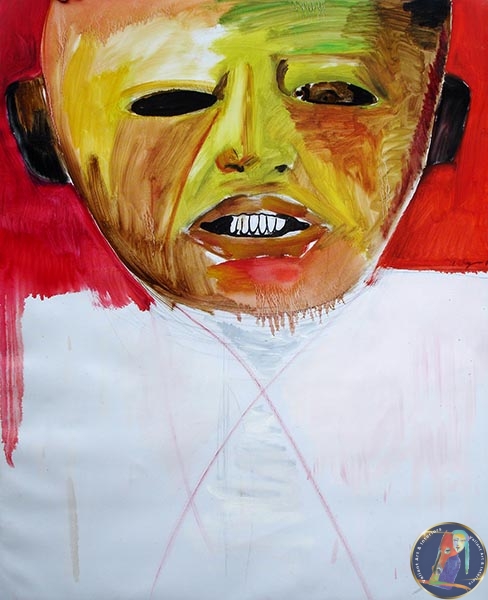
“Uvchtei Hun” (translated from Mongolian as “Sick Person”) is a poignant 2006 oil on canvas painting by the contemporary Mongolian artist Odgerel Tsulbaatar. Measuring 100 x 80 cm, the work is a compelling fusion of figurative realism and modern abstract sensibilities, reflecting the artist’s education at Ulaanbaatar’s Fine Art University.
Visual Description and Composition
The painting is a deeply psychological portrait that captures a moment of human vulnerability. True to Tsulbaatar’s signature style, the piece balances traditional Mongolian figurative elements with a contemporary, almost expressionistic approach to texture and color.
Subject Matter: The central focus is a solitary figure. The title suggests a physical or spiritual ailment, and this is communicated through the subject’s posture and the heavy, melancholic atmosphere of the canvas. The figure’s features are rendered with a blend of soft modeling and sharp, decisive brushstrokes.
Color Palette: The palette is dominated by muted, earthy tones—ochres, deep umbers, and bruised violets—punctuated by starker, high-contrast highlights that pull the viewer’s eye toward the subject’s face and hands. These colors evoke a sense of isolation and the sterile, yet suffocating, environment of illness.
Technique: Tsulbaatar utilizes the “Modern / Contemporary” style by layering the oil paint to create a rich, tactile surface. While the figure is clearly defined (Figurative), the background often dissolves into “Abstract” forms, suggesting that the subject’s internal state is bleeding into their physical surroundings.
Context and Artistic Significance
Created during a prolific year for Tsulbaatar—coinciding with the “Great Mongol 800” anniversary and his “Seeking the Real Feel I” exhibition—this painting represents a bridge between the artist’s classical training and his exploration of the modern human condition.
Cultural Intersection: As an artist born and raised in Ulaanbaatar, Tsulbaatar often explores the tension between traditional Mongolian identity and the rapid modernization of the post-Soviet era. “Uvchtei Hun” strips away cultural icons to focus on a universal human experience: frailty.
Emotional Resonance: The work is less about the clinical reality of being “sick” and more about the “Real Feel”—the subjective, emotional weight of suffering. The 100 x 80 cm scale allows for an intimate, life-sized engagement with the viewer, forcing an empathetic confrontation with the subject’s gaze.
Key Attribute: The painting is noted for its ability to convey profound stillness. Despite the heavy application of paint, there is a quietude in the composition that reflects the artist’s mastery of the “Portrait” genre within a modern Mongolian context.