
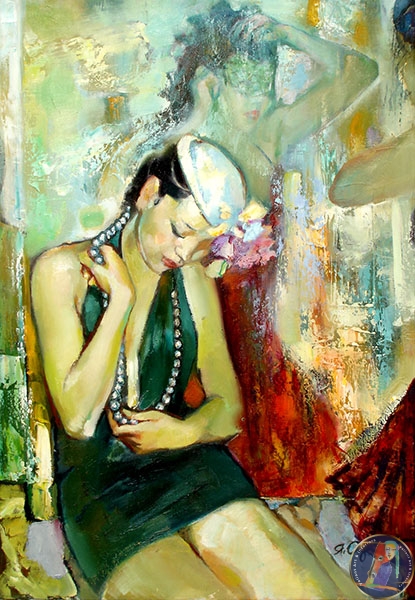
Lady is a compelling portrait that blends the rigorous technical training of the Repin Academy with the rich cultural heritage of Mongolia. Set against a minimalist, atmospheric background, the painting focuses on the dignified presence of a single female figure. The composition is a vertical 70 x 50 cm format, emphasizing the subject’s posture and the intricate details of her traditional attire.
Composition and Style
The artist employs a sophisticated realism, characterized by smooth brushwork and a mastery of light that suggests her Russian academic roots. The subject is positioned centrally, creating a sense of balance and stillness.
The Subject: The woman is depicted with a serene, introspective expression. Her features are rendered with delicate precision, capturing a timeless quality that bridges the gap between contemporary portraiture and historical Mongolian identity.
Color Palette: The palette is dominated by deep, earthy tones contrasted with vibrant highlights. Yadamsuren uses rich pigments to bring out the textures of the fabric, often utilizing jewel tones to emphasize the “Lady’s” status and the artisanal beauty of her garments.
Lighting: A soft, directional light source illuminates the figure from the side, casting gentle shadows that define the contours of her face and the heavy folds of her clothing. This “Chiaroscuro” effect adds a layer of psychological depth to the portrait.
Cultural Signifiers
The painting serves as a celebration of Mongolian femininity and craftsmanship.
Attire: The “Lady” is adorned in a traditional Deel, rendered with such detail that the viewer can almost feel the weight of the silk or brocade.
Ornamentation: Particular attention is paid to her jewelry and headpiece, which likely feature motifs traditional to the Sukhbaatar region or broader Mongolian heraldry. These elements are painted with fine-line accuracy, showcasing the artist’s ability to handle intricate patterns and reflective surfaces (such as silver or coral).
Historical Context
Created by one of Mongolia’s premiere female artists of the post-war generation, this work reflects the transition of Mongolian art from Socialist Realism toward a more personal, nationalistic expression. Having exhibited across Europe and Asia—from the American Embassy in Ulaanbaatar to Bonn and Macao—Yadamsuren’s Lady stands as a testament to the global appeal of Mongolian figurative art.