
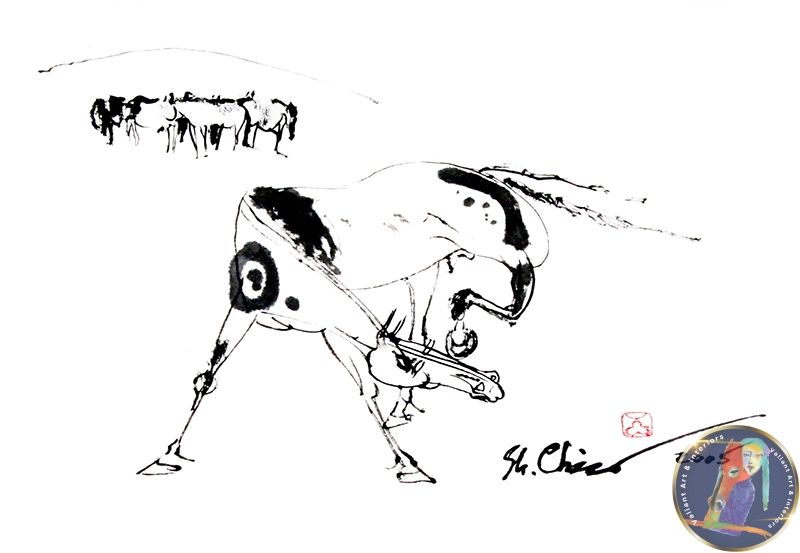
Black and White is a compelling exercise in Modern Mongolian Abstraction, reflecting Chimeddorj Shagdarjav’s mastery of minimalist form and high-contrast composition. Executed in ink on paper, the work departs from traditional representative folk art, instead leaning into a geometric and contemporary aesthetic that bridges the gap between calligraphy and modern sculpture.
Composition and Form
The painting is characterized by a bold, central arrangement of monochromatic shapes. Despite its small scale ($24 \times 26$ cm), the work possesses a monumental quality, likely influenced by the artist’s background in sculpture.
The Interplay of Mass: The composition features a dense, interlocking series of black ink strokes that suggest architectural or totemic forms. These shapes are not strictly rigid; they carry a fluid, gestural quality inherent to ink work, hinting at the movement found in the Mongolian landscape.
Negative Space: The use of the “white” (the natural tone of the paper) is as intentional as the ink itself. The negative space carves through the central mass, creating sharp angles and deep recesses that give the two-dimensional medium a sense of three-dimensional depth.
Balance: There is a tension between the heavy, saturated “Black” and the stark, open “White,” creating a visual equilibrium that feels both ancient and cutting-edge.
Style and Technique
Shagdarjav utilizes a technique that honors the heritage of Asian ink painting while firmly situating the piece within International Modernism.
Geometric Abstraction: The artist deconstructs complex subjects—possibly inspired by equine forms or the rugged Mongolian terrain—into essential lines and planes.
Ink Application: The ink varies in saturation, with some areas appearing as deep, matte voids, while the edges show the subtle bleed and texture of the paper, revealing the artist’s hand and the spontaneity of the medium.
Contextual Significance
As a graduate of the State Pedagogical Institute and a prominent figure in Mongolian contemporary art, Shagdarjav’s Black and White represents a pivotal shift in the region’s artistic identity. By stripping away color and representational detail, the artist focuses on the universal language of form, proving that the most profound expressions often exist in the simplest of palettes.