
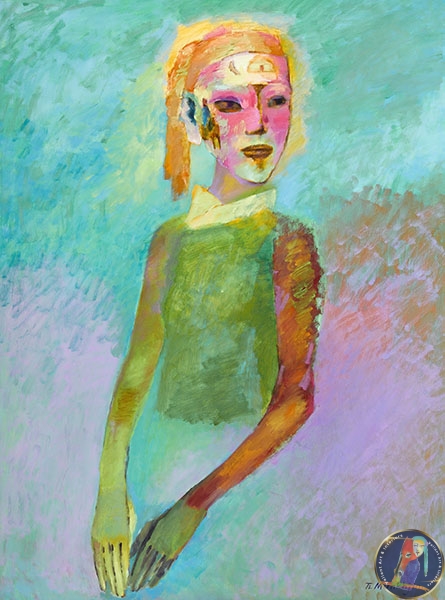
Painting 207 is a striking example of Munkhjin Tsultem’s mastery of contemporary figurative art, blending his rigorous academic training from Moscow’s Stroganoff Institute with a distinctly Mongolian modern aesthetic. Measuring 130.3 x 97 cm, the vertical composition dominates the viewer’s field of vision, offering a sophisticated interplay of form and color.
The work utilizes a rich, layered application of oil paint, characteristic of Tsultem’s 2006 period. While rooted in the figurative tradition, the painting leans into modern abstraction through its treatment of space and silhouette. The artist moves away from strict realism, instead using expressive brushwork and a nuanced palette to evoke a sense of atmospheric depth.
Artistic Elements
Form: The central figures or subjects are rendered with a sculptural quality, reflecting Tsultem’s background in design and formal structure. There is a rhythmic flow to the lines that suggests movement captured in a momentary stillness.
Color Palette: The palette likely balances earthy, traditional tones synonymous with the Mongolian landscape—ochres, deep reds, and siennas—against the cooler, deliberate strokes influenced by European modernism.
Texture: The oil medium is handled with visible confidence; some areas remain smooth and blended, while others feature a more tactile, impasto quality that catches the light and adds a physical dimension to the canvas.
Context and Influence
Created three decades after his graduation from the Stroganoff Institute, Painting 207 represents a mature phase of Tsultem’s career. It bridges the gap between the monumentalism of Soviet-era training and the post-1990s liberation of Mongolian art.
“Tsultem’s work often serves as a dialogue between the internal heritage of Ulaanbaatar and the external influences of global contemporary art.”
The painting reflects an artist who has moved beyond the “Poster” style of his early international exhibitions (like those in Lahti or Warsaw) into a more personal, introspective exploration of figure and space. It is a testament to his role as a pivotal figure in Mongolia’s modern art movement, showcasing a technical precision that never sacrifices emotional resonance.