
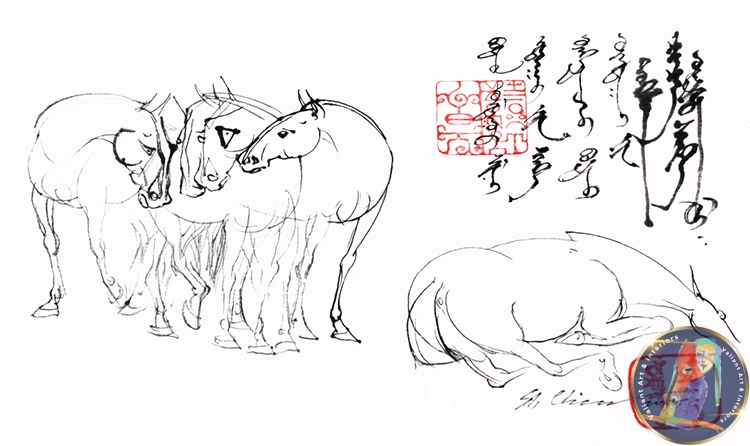
Black and White 2 is a compelling ink-on-paper composition by the renowned Mongolian contemporary artist Chimeddorj Shagdarjav. This piece serves as a sophisticated testament to Shagdarjav’s ability to bridge traditional Mongolian sensibilities with global modernism.
Visual Composition and Style
While Shagdarjav is celebrated for his work across sculpture and landscape, Black and White 2 highlights his mastery of geometric abstraction.
The Medium: Utilizing ink on paper, the artist leans into the stark, high-contrast nature of the materials. The fluidity of the ink allows for both razor-sharp precision in its geometric forms and organic, tonal depth.
Aesthetic Language: The painting likely features a rhythmic interplay of shapes—circles, lines, or angular forms—that suggest a distilled version of the Mongolian landscape or nomadic symbols. Shagdarjav often uses these minimalist elements to explore the concept of space ($void$) and substance ($matter$).
Balance: Given its dimensions (25 x 36cm), the work is intimate. It focuses on the tension between the dark ink and the negative space of the paper, creating a visual “silence” that is characteristic of his modern style.
Context and Origin
Artist: Chimeddorj Shagdarjav (b. 1954, Ulaanbaatar/Tuv Aimag).
Education: His formal training at the State Pedagogical Institute (graduated 1984) provided a foundation in classical techniques, which he later deconstructed to become a pioneer of the Mongolian “New Art” movement.
Significance: This piece represents the shift in Mongolian art from socialist realism toward a more personal, abstract, and international dialogue. It emphasizes form and emotion over literal representation.
Technical Specifications
| Feature | Detail |
| Material | Ink on Paper |
| Dimensions | 25 x 36 cm |
| Accession Number | CHD18/009-02 |
| Movement | Modern / Contemporary Abstraction |
Note: The “Black and White” series is frequently cited in discussions regarding the evolution of Mongolian ink painting, where Shagdarjav strips away color to focus entirely on the energy and “spirit” of the line work.