
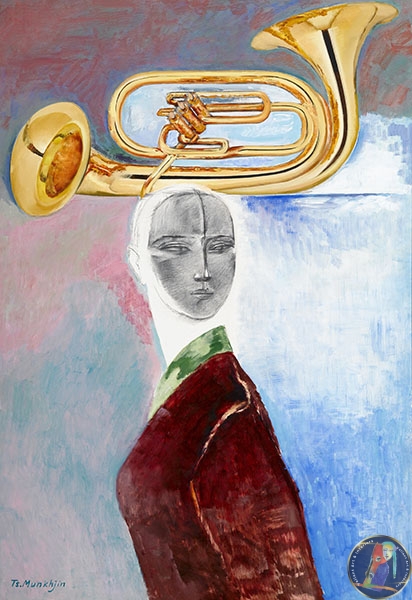
Lady With Horn

Munkhjin Tsultem , 1999 , Oil On Canvas

Lady With Horn is a striking example of Munkhjin Tsultem’s mastery of contemporary figurative art, blending his formal Russian academic training with the deep, symbolic heritage of Mongolia. Painted in 1999, this large-scale oil on canvas stands as a testament to the artist’s ability to elevate the human form into a realm of myth and modern mystery.

Visual Composition

The painting features a central female figure, rendered with a sophisticated balance of anatomical precision and stylistic abstraction. The “Horn” referenced in the title serves as the focal point—an element that bridges the gap between the earthly and the spiritual. It is integrated into the composition not merely as an accessory, but as a symbolic extension of the subject’s identity, perhaps nodding to Siberian shamanic traditions or Central Asian folklore.

Style and Technique

Drawing from his education at the Stroganoff Institute of Art and Design, Tsultem employs a rich, layered application of oil paint. The brushwork reflects a “Modern Contemporary” sensibility:

  • Color Palette: The artist typically utilizes a sophisticated palette where earthy, grounded tones meet ethereal highlights, creating a sense of timelessness.

  • Form: While the figure is clearly defined (Figurative), there is a rhythmic fluidity to the lines that suggests movement and internal energy.

  • Atmosphere: The 128.5 x 88.5 cm dimensions provide a vertical, commanding presence, allowing the viewer to engage with the subject at a nearly life-sized scale.

Context and Significance

Created during a period when Mongolian artists were increasingly exploring national identity through the lens of international modernism, this work captures a unique cultural intersection. Tsultem’s experience in major international hubs—from Moscow to Fukuoka—is evident in the painting’s polished execution and its ability to communicate a universal “human” story through a specifically Mongolian aesthetic lens.
  • Munkhjin Tsultem
  • Expressionist, Figurative
  • Oil On Canvas
  • MUN35/009
  • 128.5 x 88.5cm
  • Mongolian Art Gallery

Add Your Comment

Mongolian Art Gallery © 2025. All Rights Reserved
Privacy Policy / Terms of Use

Lady With Horn is a striking example of Munkhjin Tsultem’s mastery of contemporary figurative art, blending his formal Russian academic training with the deep, symbolic heritage of Mongolia. Painted in 1999, this large-scale oil on canvas stands as a testament to the artist’s ability to elevate the human form into a realm of myth and modern mystery.

Visual Composition

The painting features a central female figure, rendered with a sophisticated balance of anatomical precision and stylistic abstraction. The “Horn” referenced in the title serves as the focal point—an element that bridges the gap between the earthly and the spiritual. It is integrated into the composition not merely as an accessory, but as a symbolic extension of the subject’s identity, perhaps nodding to Siberian shamanic traditions or Central Asian folklore.

Style and Technique

Drawing from his education at the Stroganoff Institute of Art and Design, Tsultem employs a rich, layered application of oil paint. The brushwork reflects a “Modern Contemporary” sensibility:

  • Color Palette: The artist typically utilizes a sophisticated palette where earthy, grounded tones meet ethereal highlights, creating a sense of timelessness.

  • Form: While the figure is clearly defined (Figurative), there is a rhythmic fluidity to the lines that suggests movement and internal energy.

  • Atmosphere: The 128.5 x 88.5 cm dimensions provide a vertical, commanding presence, allowing the viewer to engage with the subject at a nearly life-sized scale.

Context and Significance

Created during a period when Mongolian artists were increasingly exploring national identity through the lens of international modernism, this work captures a unique cultural intersection. Tsultem’s experience in major international hubs—from Moscow to Fukuoka—is evident in the painting’s polished execution and its ability to communicate a universal “human” story through a specifically Mongolian aesthetic lens.