
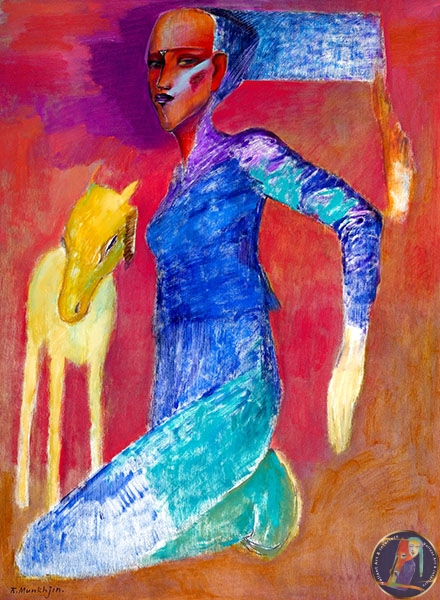
Red Face Woman With Horn

Munkhjin Tsultem , 2003 , Oil On Canvas

In this striking contemporary work, Munkhjin Tsultem blends the rigorous formal training of the Moscow Stroganoff Institute with the profound cultural heritage of Mongolia. Red Face Woman With Horn is a large-scale figurative piece that commands attention through its bold palette and surrealist undertones.

The composition centers on a female figure whose features are rendered in a deep, saturated crimson. This “red face” serves as a powerful focal point, evoking themes of intense emotion, spiritual possession, or perhaps the biting cold of the Mongolian steppe. The artist utilizes his background in Modern Figurative art to balance realistic proportions with expressive, symbolic distortions.

Symbolism and Aesthetic

The most provocative element of the painting is the horn—a motif that bridges the gap between the human and the mythological. In the context of Mongolian contemporary art, such imagery often references:

  • Shamanistic traditions: Where animal totems and human forms intertwine.

  • Dualism: The tension between the delicate nature of the female subject and the sharp, powerful presence of the horn.

Tsultem’s brushwork is confident and textured, a hallmark of his mastery of oil on canvas. The background likely serves as an atmospheric void or a minimalist landscape, ensuring that the 130 x 97 cm frame is dominated by the psychological weight of the subject.

Historical and Artistic Context

Painted in 2003, this work represents Tsultem’s mature period, post-dating his international exhibitions in Poland, Finland, and Japan. While his early career was marked by the precision of poster design (as seen in his 1986 Lahti exhibition), Red Face Woman With Horn displays a move toward Contemporary Symbolism. It reflects a generation of Mongolian artists who, after the transition to democracy in 1990, felt empowered to explore identity, folklore, and avant-garde aesthetics without the constraints of Socialist Realism.
  • Munkhjin Tsultem
  • Figurative, Minimalist
  • Oil On Canvas
  • MUN35/007
  • 130 x 97cm
  • Mongolian Art Gallery

Add Your Comment

Mongolian Art Gallery © 2025. All Rights Reserved
Privacy Policy / Terms of Use

In this striking contemporary work, Munkhjin Tsultem blends the rigorous formal training of the Moscow Stroganoff Institute with the profound cultural heritage of Mongolia. Red Face Woman With Horn is a large-scale figurative piece that commands attention through its bold palette and surrealist undertones.

The composition centers on a female figure whose features are rendered in a deep, saturated crimson. This “red face” serves as a powerful focal point, evoking themes of intense emotion, spiritual possession, or perhaps the biting cold of the Mongolian steppe. The artist utilizes his background in Modern Figurative art to balance realistic proportions with expressive, symbolic distortions.

Symbolism and Aesthetic

The most provocative element of the painting is the horn—a motif that bridges the gap between the human and the mythological. In the context of Mongolian contemporary art, such imagery often references:

  • Shamanistic traditions: Where animal totems and human forms intertwine.

  • Dualism: The tension between the delicate nature of the female subject and the sharp, powerful presence of the horn.

Tsultem’s brushwork is confident and textured, a hallmark of his mastery of oil on canvas. The background likely serves as an atmospheric void or a minimalist landscape, ensuring that the 130 x 97 cm frame is dominated by the psychological weight of the subject.

Historical and Artistic Context

Painted in 2003, this work represents Tsultem’s mature period, post-dating his international exhibitions in Poland, Finland, and Japan. While his early career was marked by the precision of poster design (as seen in his 1986 Lahti exhibition), Red Face Woman With Horn displays a move toward Contemporary Symbolism. It reflects a generation of Mongolian artists who, after the transition to democracy in 1990, felt empowered to explore identity, folklore, and avant-garde aesthetics without the constraints of Socialist Realism.