
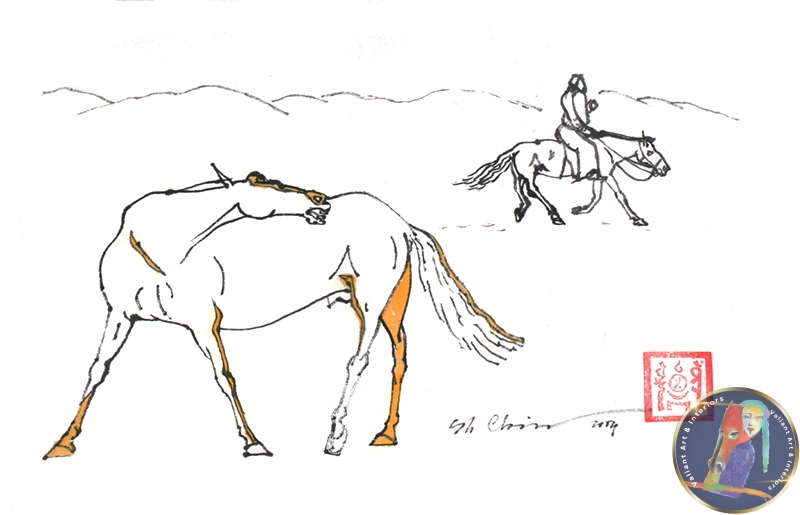
Black and White is a striking testament to Chimeddorj Shagdarjav’s ability to merge traditional Mongolian sensibilities with Modernist abstraction. Utilizing the stark, high-contrast medium of ink on paper, the work leans heavily into the Geometric and Abstract styles for which the artist is renowned.
The composition is characterized by a sophisticated play between positive and negative space. Shagdarjav employs bold, calligraphic strokes that suggest the fluid motion of the Mongolian landscape or perhaps the skeletal forms of horses—a recurring motif in his broader body of work. However, in this specific piece, those forms are distilled into their most basic structural elements.
Visual Analysis
Contrast and Tone: The title serves as a literal roadmap for the visual experience. The deep, saturated blacks of the ink stand in sharp defiance against the stark white of the paper. This binary palette emphasizes the geometric precision of the shapes, stripping away the distraction of color to focus on form and rhythm.
Compositional Rhythm: There is a palpable sense of movement within the 28 x 48 frame. The horizontal orientation allows the eye to sweep across the piece, mirroring the vast expanses of the Mongolian steppe. The ink is applied with varying pressures; some areas appear dense and architectural, while others show the feathered edges of a dry brush technique, suggesting speed and spontaneity.
Style and Influence: While the artist is also a celebrated sculptor, his “sculptural eye” is evident here in the way the ink shapes seem to occupy three-dimensional space. The work bridges the gap between Contemporary abstraction and the minimalist heritage of Asian ink wash traditions.
Contextual Significance
Graduating from the State Pedagogical Institute in 1984, Shagdarjav emerged during a transformative era in Mongolian art. Black and White represents his departure from strict socialist realism toward a more personal, Modernist language. By reducing his subject matter to monochromatic geometry, he invites the viewer to find meaning in the balance of the elements rather than in a literal representation.
“In the hands of Shagdarjav, the simplicity of ink on paper becomes a powerful tool for exploring the duality of existence—strength and fragility, presence and absence.”