
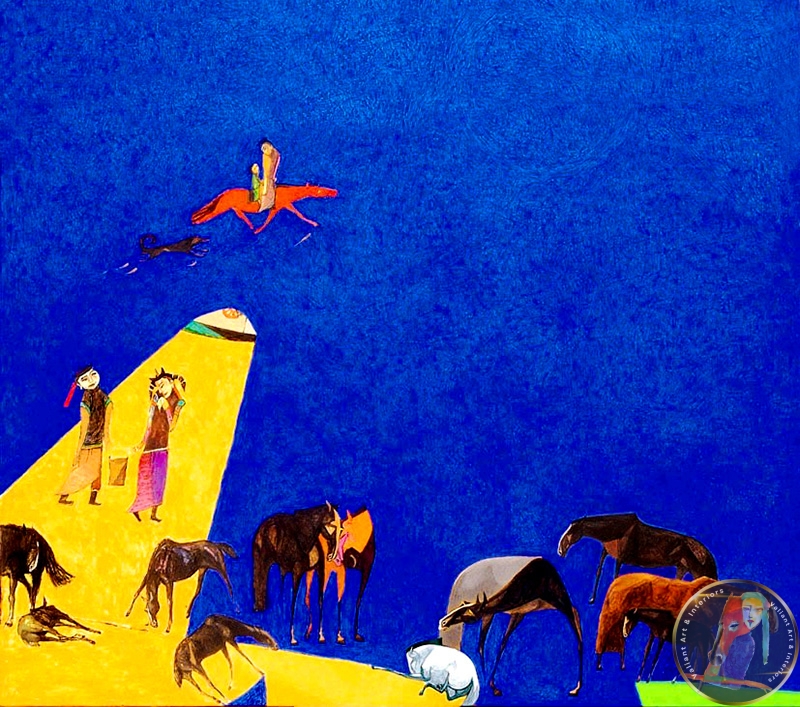
Autumn Days is a significant oil on canvas work by the renowned Mongolian contemporary artist Chimeddorj Shagdarjav. This large-scale piece (159.6 x 179 cm) serves as a profound intersection of traditional Mongolian sensibilities and the geometric abstraction that defines Shagdarjav’s modern style.
Visual Composition and Style
The painting is a masterful blend of Modernism and Landscape, moving away from literal representation toward a more Geometric and Abstract interpretation of the Mongolian wilderness.
Structure: Shagdarjav utilizes bold, deliberate brushwork and structural lines to partition the canvas. The composition often balances expansive horizons with rhythmic, repetitive shapes that suggest the undulating movement of the steppe or the physical presence of livestock.
Color Palette: True to its title, the work is dominated by the rich, earthy tones of a Mongolian autumn. Expect a sophisticated layering of ochres, deep ambers, and burnt sienna, contrasted against the cool, receding blues of a vast sky or distant mountain ranges.
Abstraction: While the subject is rooted in the “Autumn Days” of the nomadic landscape, the artist simplifies forms into essential geometric blocks. This technique creates a sense of “sculptural painting,” where the elements on the canvas feel as though they have weight and three-dimensional presence.
Thematic Essence
Chimeddorj Shagdarjav is celebrated for his ability to capture the “spirit” of Mongolia—specifically the horse and the boundless plains—without relying on clichés. In Autumn Days, the atmosphere is one of tranquil transition. The vast dimensions of the canvas (nearly 1.8 meters wide) immerse the viewer in the scale of the environment, evoking the silence and the sharp, crisp air of the changing season.
Technical Details
Artist: Chimeddorj Shagdarjav (b. 1954, Ulaanbaatar/Tuv Aimag)
Medium: Oil on Canvas
Dimensions: 159.6 x 179 cm
Accession Number: CHD18/008
Educational Context: The technical precision in the layering of oils reflects his formal training at the State Pedagogical Institute in Ulaanbaatar, which he completed in 1984.
Significance: This painting represents the post-socialist transition in Mongolian art, where artists like Shagdarjav broke free from socialist realism to explore personal, abstract expressions of national identity.