
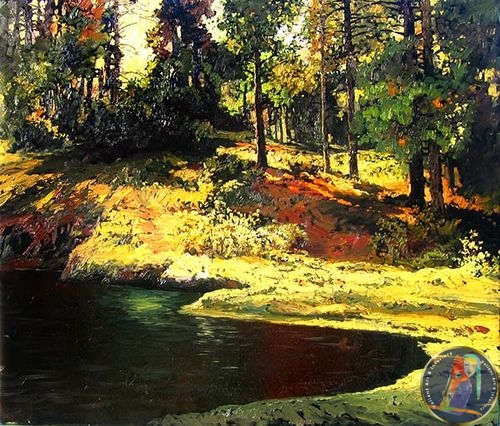
The painting centers on the transitional moments of dawn, a theme that serves as both a literal setting and a metaphor for the nomadic way of life. Baidy employs a realistic yet atmospheric style to depict the start of the day.
The Subject: The piece likely features a central figure—often a nomad or a horseman—integrated seamlessly into the environment. Given Baidy’s association with the International Equestrian Festival, his figures often possess a rugged dignity, captured in the midst of morning rituals such as preparing a horse or surveying the horizon.
Light and Color: The palette is dominated by the soft, cool hues of early light—pale blues, soft lavenders, and muted golds. Baidy uses the oil medium to create a luminous quality, mimicking the way the sun first hits the dew-heavy grass of the Dundgobi region.
The Landscape: The vastness of the Mongolian sky occupies a significant portion of the canvas, emphasizing the scale of nature relative to man. The brushwork in the distance is soft and blended, providing a sense of infinite space, while the foreground details of the steppe flora are rendered with sharp, figurative precision.
Style and Technique
Baidy, born in 1976 and educated in Mongolia, represents a generation of artists who honor traditional nomadic themes through a modern realist lens.
Realism & Figurative Detail: The skin tones of the subjects and the textures of traditional clothing (like the deel) are painted with anatomical accuracy and a keen eye for material weight.
Emotional Resonance: Unlike purely documentary realism, “Morning” carries a quiet, contemplative weight. There is a sense of “stillness in motion,” a hallmark of Baidy’s work that suggests the timelessness of the Mongolian landscape.
Historical Context
Created five years before his inclusion in the 2010 International Equestrian Festival in Kentucky, “Morning” represents a pivotal period in Baidy’s career where he refined his ability to communicate Mongolian identity to a global audience. The painting stands as a tribute to his birthplace in Mandalgobi, capturing the harsh beauty and serene beginnings of life in the Gobi desert.