My Brother

Nandin-erdene Budzagd , 2006 , Mixed Media

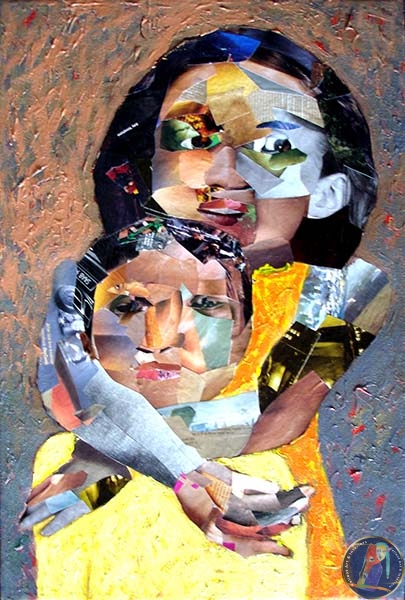
“My Brother” is a compelling mixed-media work that serves as a bridge between Nandin-erdene Budzagd’s academic mastery and her emergence as a leading voice in contemporary Mongolian art. Created in 2006—the same year she completed her Master’s degree at the University of Arts and Culture in Ulaanbaatar—the piece reflects a sophisticated synthesis of cultural heritage and modern abstraction.

Visual Composition and Style

The painting occupies a vertical 80 x 60cm format, a scale that feels intimate yet commanding. Budzagd employs a minimalist color palette, often characterized by earthy tones, deep ochres, or muted grays, which underscores the somber and reflective nature of the subject.

The work sits at the intersection of figurative and geometric abstraction:

  • The Figure: The “brother” is not rendered with photographic realism. Instead, the form is distilled into essential lines and shapes, suggesting a presence that is as much a memory as it is a physical person.

  • Geometric Framing: True to her signature style, Budzagd uses sharp, deliberate lines and geometric blocks to structure the composition. These elements act as a scaffold, perhaps representing the rigid societal or architectural environments of modern Mongolia.

  • Textural Depth: As a mixed-media piece, the surface is tactile. The artist likely layered pigments with unconventional materials—such as sand, fabric, or paper—creating a weathered, “living” texture that mimics the aged walls of a monastery or the rugged Mongolian landscape.

Themes and Interpretation

In “My Brother,” the artist explores the tension between individual identity and the collective experience. By stripping away specific facial details, the figure becomes a universal symbol of kinship. There is a sense of quietude and stillness inherent in the work, achieved through the minimalist arrangement.

The influence of her Mongolian roots is subtle but pervasive. The structural harmony of the piece mirrors the balance found in traditional Buddhist art, yet the execution is firmly rooted in the global contemporary movement.
  • Nandin-erdene Budzagd
  • Abstract, Calligraphy, Expressionist
  • Oil On Canvas
  • NAE39/009
  • 80 x 60cm
  • Mongolian Art Gallery

Add Your Comment

Mongolian Art Gallery © 2025. All Rights Reserved
Privacy Policy / Terms of Use

“My Brother” is a compelling mixed-media work that serves as a bridge between Nandin-erdene Budzagd’s academic mastery and her emergence as a leading voice in contemporary Mongolian art. Created in 2006—the same year she completed her Master’s degree at the University of Arts and Culture in Ulaanbaatar—the piece reflects a sophisticated synthesis of cultural heritage and modern abstraction.

Visual Composition and Style

The painting occupies a vertical 80 x 60cm format, a scale that feels intimate yet commanding. Budzagd employs a minimalist color palette, often characterized by earthy tones, deep ochres, or muted grays, which underscores the somber and reflective nature of the subject.

The work sits at the intersection of figurative and geometric abstraction:

  • The Figure: The “brother” is not rendered with photographic realism. Instead, the form is distilled into essential lines and shapes, suggesting a presence that is as much a memory as it is a physical person.

  • Geometric Framing: True to her signature style, Budzagd uses sharp, deliberate lines and geometric blocks to structure the composition. These elements act as a scaffold, perhaps representing the rigid societal or architectural environments of modern Mongolia.

  • Textural Depth: As a mixed-media piece, the surface is tactile. The artist likely layered pigments with unconventional materials—such as sand, fabric, or paper—creating a weathered, “living” texture that mimics the aged walls of a monastery or the rugged Mongolian landscape.

Themes and Interpretation

In “My Brother,” the artist explores the tension between individual identity and the collective experience. By stripping away specific facial details, the figure becomes a universal symbol of kinship. There is a sense of quietude and stillness inherent in the work, achieved through the minimalist arrangement.

The influence of her Mongolian roots is subtle but pervasive. The structural harmony of the piece mirrors the balance found in traditional Buddhist art, yet the execution is firmly rooted in the global contemporary movement.