
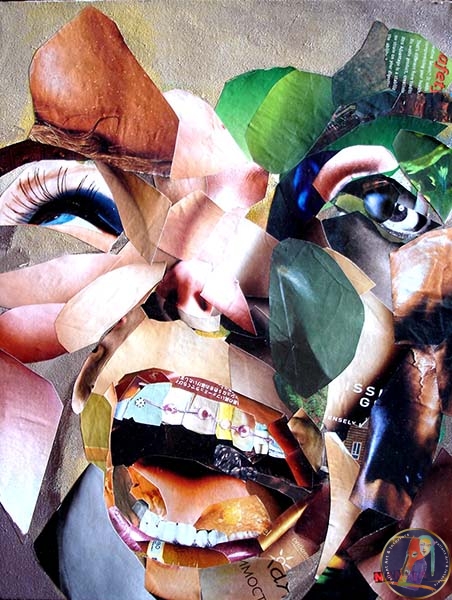
Created during the final year of Budzagd’s Master’s studies at the University of Arts and Culture in Ulaanbaatar, “Face” is a sophisticated exploration of identity filtered through a lens of Minimalism and Geometric Abstraction.
Composition & Form The painting presents a stylized, non-traditional portrait that bridges the gap between the human form and mathematical precision. Rather than a literal rendering of features, the “face” is constructed through a series of intersecting planes and sharp, clean lines. This geometric approach deconstructs the subject into essential shapes—circles, triangles, or elongated rectangles—suggesting a face that is both structural and ephemeral.
Style & Aesthetic The influence of Mongolian modernism is evident in the work’s economy of means. By utilizing a Minimalist aesthetic, Budzagd strips away extraneous detail to focus on the rhythmic balance of the composition. The Figurative element remains the anchor, but it is heavily abstracted, inviting the viewer to piece together the persona from the layered textures of the mixed media.
Texture & Palette The use of mixed media adds a tactile dimension to the 80 x 60 cm surface. The artist likely incorporates varying thicknesses of pigment or added materials to create a surface that catches the light differently across its geometric segments. The color palette typically associated with Budzagd’s mid-2000s period leans toward earthy, grounded tones—perhaps ochres, deep reds, or muted grays—which contrast with the sharp, modernistic linework.