
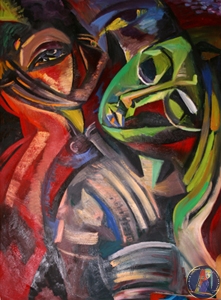
Three Faces is a substantial oil on canvas work, measuring 100 x 150 cm, that exemplifies Ganbold’s synthesis of contemporary abstraction and figurative exploration. The painting utilizes a wide, horizontal orientation to present a triptych-like arrangement of human forms, though they are unified within a single, cohesive atmospheric space.
Composition and Style
True to Ganbold’s associated styles, the piece bridges the gap between Modern Figurative art and Abstract Expressionism.
The Subjects: The composition centers on three distinct yet overlapping figures. While the title suggests a focus on “Faces,” the work incorporates elements of the Nude form, rendered with a fluid, anatomical grace that prioritizes movement and emotion over rigid realism.
The Palette: Typical of Ganbold’s mid-2000s “Freedom” and “Aphorism” era, the color story likely employs a mix of earthy Mongolian tones—ochres, deep reds, or siennas—juxtaposed with modern, cooler accents to create depth.
Brushwork: The application of oil paint is handled with a “Contemporary” urgency. Expect visible, textured brushstrokes that blur the boundaries between the figures and the background, suggesting that the “Three Faces” are perhaps three different facets of a single psyche or a collective consciousness.
Thematic Context
Given the artist’s history of exhibitions like Freedom (2007) and Aphorizm in Art, this painting serves as a visual metaphor. The larger-than-life dimensions (1.5 meters wide) allow the viewer to be enveloped by the subjects. The “Three Faces” may represent:
Temporal States: Past, present, and future.
Internal Conflict: The masks one wears versus the raw, figurative self.
Cultural Dialogue: A modern Mongolian artist’s perspective on universal human vulnerability.
Technical Specifications
Medium: Oil on Canvas
Scale: 100 x 150 cm (Large-scale horizontal format)
Style: Abstract-Figurative Modernism
This work stands as a testament to Ganbold’s ability to take the traditional nude and figurative form and recontextualize it through a lens of post-modern Mongolian abstraction.