
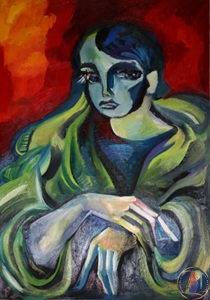
Green Lady is a commanding example of Modern Contemporary art, blending elements of Abstract expressionism with Figurative realism. Measuring 100 x 150 cm, the large-scale horizontal canvas provides an expansive stage for Ganbold’s exploration of the human form. The work leans heavily into the Nude genre, utilizing the raw honesty of the unclothed figure to convey emotion rather than mere anatomical study.
Visual Analysis
The painting is characterized by a bold, atmospheric use of color, dominated by the verdant tones suggested in its title. Ganbold employs a sophisticated palette of emerald, moss, and deep forest greens, often contrasted against warmer, earthy undertones to give the subject life.
The Subject: The central figure—the “Green Lady”—is rendered with a fluid, rhythmic quality. While the anatomy is grounded in figurative tradition, the edges of the form often dissolve into the background, suggesting a symbiotic relationship between the individual and their environment.
Brushwork: The artist’s technique involves a dynamic mix of broad, sweeping strokes and more delicate, textured layering. This creates a surface that feels alive, capturing the interplay of light and shadow across the skin through a modern, non-traditional lens.
Mood: There is an inherent sense of “Freedom” and “Aphorism” in the work—themes present in Ganbold’s solo exhibitions. The subject exudes a quiet strength and introspection, typical of the Mongolian contemporary art movement which often bridges nomadic heritage with urban modernism.
Contextual Significance
Created by an artist who gained recognition as early as the late 1990s in Beijing and Shanghai, Green Lady represents the maturity of Ganbold’s style. It stands as a testament to his ability to navigate the complexities of the human silhouette while maintaining a high degree of abstraction, positioning him as a pivotal voice in Ulaanbaatar’s vibrant art scene.
Note on the Artist: Ganbold Dorjderem, often known by the name Bono, is a graduate of the era that saw Mongolian art transition into global contemporary dialogues. His participation in the “Great Mongolia 800” exhibition underscores his importance in the nation’s cultural narrative.