
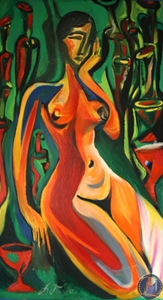
Setting Woman is a compelling synthesis of Modern Contemporary aesthetics and Figurative exploration. Painted by the Mongolian artist Ganbold (Bono) Dorjderem, the work utilizes an elongated horizontal canvas ($70 \times 120$ cm) to create a sense of expansive, atmospheric space that complements the vulnerability and poise of the subject.
Composition and Subject Matter
The painting centers on a nude female figure, rendered with a delicate balance between realism and Abstract simplification. The “setting” of the woman suggests a moment of profound stillness—perhaps a transition between states of being or a quiet reflection within a minimalist environment. The figure is positioned to interact with the vastness of the canvas, emphasizing the artist’s signature style of blending human anatomy with fluid, modern forms.
Color Palette and Texture
Ganbold employs a sophisticated application of Oil on Canvas, likely utilizing layered glazes or textured brushwork to evoke depth.
The Figure: Typically characterized by soft, organic curves and a play of light that highlights the skeletal and muscular structure without sacrificing the softness of the form.
The Background: Often leaning toward the abstract, the environment surrounding the woman likely uses a muted or atmospheric palette, allowing the viewer’s focus to remain fixed on the emotive quality of the pose.
Style and Emotional Resonance
Reflecting the artist’s history of solo exhibitions like “Freedom” and “Aphorizm in Art,” this piece moves beyond simple portraiture. It serves as a visual aphorism—a concise expression of a complex truth. The Nude form is treated not merely as an object of study, but as a vessel for contemporary expression, bridging the gap between traditional Mongolian artistic sensibilities and global Modernism.
Artist Context
Bono Dorjderem emerged as a significant voice in the Mongolian art scene at a young age, exhibiting in major centers like Beijing and Shanghai by 1997. Setting Woman represents the maturity of a style developed through a decade of rigorous exhibition, including the prestigious “Great Mongolia 800” joint exhibition. His work is celebrated for its ability to capture the “freedom” of the human spirit through a lens that is both distinctly Mongolian and universally modern.