
Thinking

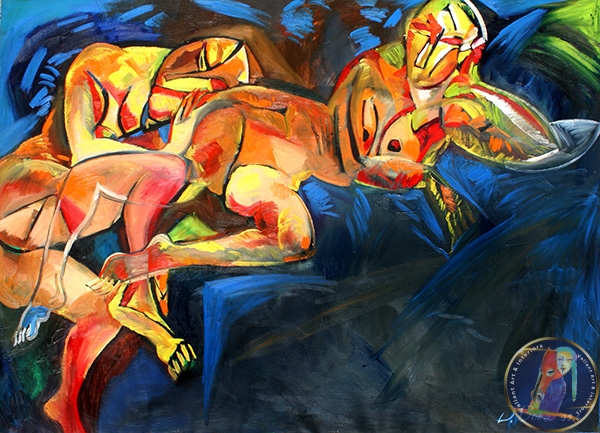
Ganbold / Bono Dorjderem , 2009 , Oil On Canvas

Thinking is a large-scale oil painting that masterfully bridges the gap between Modern Figurative art and Contemporary Abstraction. Measuring 105 x 157 cm, the work utilizes its expansive horizontal canvas to explore the internal landscape of the human psyche. True to Dorjderem’s established style, the piece centers on the human form—specifically a nude figure—but treats the body as a vessel for philosophical inquiry rather than mere anatomical study.

Composition and Style

The painting is characterized by a sophisticated interplay of texture and form. Dorjderem employs an abstracted figurative approach, where the boundaries of the subject often bleed into the background, suggesting a dissolution of the self into the act of contemplation.

  • The Figure: The central subject is depicted in a state of repose or deep introspection. The artist uses expressive, gestural brushwork to define the musculature and posture, favoring emotional resonance over photographic realism.

  • Color Palette: The palette likely draws from the earthy, atmospheric tones often found in Mongolian contemporary art, punctuated by the bold, emotive shifts typical of the “Aphorizm in art” and “Freedom” periods of the artist’s career.

  • Space: There is a distinct sense of “Modernist flatness” combined with depth created through layered oil paint. The background does not represent a physical room but rather an intellectual or spiritual space.

Thematic Context

Given the title Thinking, the painting functions as a visual aphorism. It captures the stillness and weight of intellectual labor. As an artist who rose to prominence during the “Great Mongolia 800” era and subsequently explored themes of “Freedom,” Dorjderem uses the nude here to represent humanity in its most vulnerable and honest state—stripped of cultural signifiers and left only with thought.

Artistic Significance

This piece represents a mature phase of Dorjderem’s work, following his early success in the late 90s (Beijing/Shanghai) and his debut solo exhibitions. It reflects a transition from traditional Mongolian aesthetics toward a global Contemporary language. The large dimensions (157 cm width) command the viewer’s physical presence, forcing an intimate engagement with the “thinker” depicted on the canvas.

Summary Note: Thinking is a pivotal example of 21st-century Mongolian modernism, showcasing Ganbold Dorjderem’s ability to translate complex psychological states into a tactile, visual medium.

  • Ganbold / Bono Dorjderem
  • Ulaanbaatar, Mongolia
  • Abstract, Figurative, Modern/Contemporary, Nude
  • Oil On Canvas
  • GND81/045
  • 105 x 157 cm
  • Valiant Art & Interiors

Add Your Comment

Mongolian Art Gallery © 2025. All Rights Reserved
Privacy Policy / Terms of Use

Thinking is a large-scale oil painting that masterfully bridges the gap between Modern Figurative art and Contemporary Abstraction. Measuring 105 x 157 cm, the work utilizes its expansive horizontal canvas to explore the internal landscape of the human psyche. True to Dorjderem’s established style, the piece centers on the human form—specifically a nude figure—but treats the body as a vessel for philosophical inquiry rather than mere anatomical study.

Composition and Style

The painting is characterized by a sophisticated interplay of texture and form. Dorjderem employs an abstracted figurative approach, where the boundaries of the subject often bleed into the background, suggesting a dissolution of the self into the act of contemplation.

  • The Figure: The central subject is depicted in a state of repose or deep introspection. The artist uses expressive, gestural brushwork to define the musculature and posture, favoring emotional resonance over photographic realism.

  • Color Palette: The palette likely draws from the earthy, atmospheric tones often found in Mongolian contemporary art, punctuated by the bold, emotive shifts typical of the “Aphorizm in art” and “Freedom” periods of the artist’s career.

  • Space: There is a distinct sense of “Modernist flatness” combined with depth created through layered oil paint. The background does not represent a physical room but rather an intellectual or spiritual space.

Thematic Context

Given the title Thinking, the painting functions as a visual aphorism. It captures the stillness and weight of intellectual labor. As an artist who rose to prominence during the “Great Mongolia 800” era and subsequently explored themes of “Freedom,” Dorjderem uses the nude here to represent humanity in its most vulnerable and honest state—stripped of cultural signifiers and left only with thought.

Artistic Significance

This piece represents a mature phase of Dorjderem’s work, following his early success in the late 90s (Beijing/Shanghai) and his debut solo exhibitions. It reflects a transition from traditional Mongolian aesthetics toward a global Contemporary language. The large dimensions (157 cm width) command the viewer’s physical presence, forcing an intimate engagement with the “thinker” depicted on the canvas.

Summary Note: Thinking is a pivotal example of 21st-century Mongolian modernism, showcasing Ganbold Dorjderem’s ability to translate complex psychological states into a tactile, visual medium.