
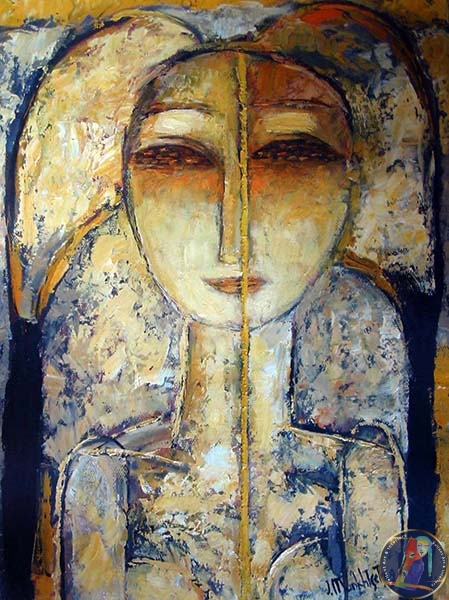
Concentration Ii

Munkhtsetseg Jalkhaajav , 2004 , Oil On Canvas

Munkhtsetseg Jalkhaajav’s 2004 work, Concentration II, is a compelling testament to the artist’s mastery of contemporary figurative art, blending Mongolian spiritual traditions with a modern, psychological depth. Painted in oil on a relatively intimate $30 \times 40\text{cm}$ canvas, the piece captures a profound sense of stillness and internal focus.

Visual Composition and Style

The painting is characterized by Jalkhaajav’s signature “Abstract Modern” approach, where the human form is treated not just as a physical entity, but as a vessel for energy and emotion.

  • The Subject: Central to the composition is a figure depicted in a state of intense meditative repose. True to the title, the work explores the concept of concentration—not merely as a mental task, but as a physical and spiritual alignment.

  • The Palette: Given Jalkhaajav’s background and the period of the early 2000s, the color story often leans into earthy, grounded tones interspersed with ethereal highlights. The oil medium allows for rich, layered textures that suggest the weight of the physical body against the lightness of the mind.

  • Figurative Distortion: Subtle abstractions in the anatomy serve to emphasize the “internal” over the “external.” The limbs or features may be simplified or elongated, directing the viewer’s eye toward the center of the figure’s gravity.

Cultural and Artistic Context

Born in Ulaanbaatar and educated in both Mongolia and Minsk, Jalkhaajav (often referred to as Mugi) brings a unique Eurasian perspective to her work.

  • Mongolian Influence: The painting reflects the artist’s deep connection to the healing rituals and spiritual philosophies of Mongolia. The “concentration” depicted is reminiscent of shamanic or Buddhist practices where the individual seeks to harmonize with the cosmos.

  • Contemporary Dialogue: While rooted in tradition, the execution belongs firmly to the global contemporary scene. The minimalist size ($30 \times 40\text{cm}$) forces a personal, close-up encounter between the viewer and the subject, mirroring the privacy of the act of concentration itself.
  • Munkhtsetseg Jalkhaajav
  • Abstract, Calligraphy, Expressionist
  • Oil On Canvas
  • MUK37/017
  • 30 x 40cm
  • Mongolian Art Gallery

Add Your Comment

Mongolian Art Gallery © 2025. All Rights Reserved
Privacy Policy / Terms of Use

Munkhtsetseg Jalkhaajav’s 2004 work, Concentration II, is a compelling testament to the artist’s mastery of contemporary figurative art, blending Mongolian spiritual traditions with a modern, psychological depth. Painted in oil on a relatively intimate $30 \times 40\text{cm}$ canvas, the piece captures a profound sense of stillness and internal focus.

Visual Composition and Style

The painting is characterized by Jalkhaajav’s signature “Abstract Modern” approach, where the human form is treated not just as a physical entity, but as a vessel for energy and emotion.

  • The Subject: Central to the composition is a figure depicted in a state of intense meditative repose. True to the title, the work explores the concept of concentration—not merely as a mental task, but as a physical and spiritual alignment.

  • The Palette: Given Jalkhaajav’s background and the period of the early 2000s, the color story often leans into earthy, grounded tones interspersed with ethereal highlights. The oil medium allows for rich, layered textures that suggest the weight of the physical body against the lightness of the mind.

  • Figurative Distortion: Subtle abstractions in the anatomy serve to emphasize the “internal” over the “external.” The limbs or features may be simplified or elongated, directing the viewer’s eye toward the center of the figure’s gravity.

Cultural and Artistic Context

Born in Ulaanbaatar and educated in both Mongolia and Minsk, Jalkhaajav (often referred to as Mugi) brings a unique Eurasian perspective to her work.

  • Mongolian Influence: The painting reflects the artist’s deep connection to the healing rituals and spiritual philosophies of Mongolia. The “concentration” depicted is reminiscent of shamanic or Buddhist practices where the individual seeks to harmonize with the cosmos.

  • Contemporary Dialogue: While rooted in tradition, the execution belongs firmly to the global contemporary scene. The minimalist size ($30 \times 40\text{cm}$) forces a personal, close-up encounter between the viewer and the subject, mirroring the privacy of the act of concentration itself.