
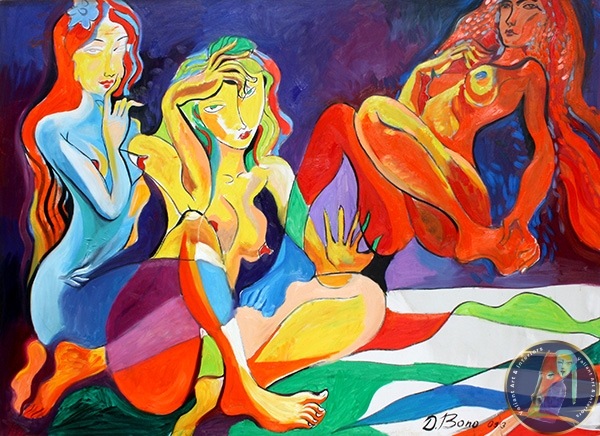
In this expansive oil painting, Ganbold (Bono) Dorjderem explores the intersection of Contemporary Abstract and Figurative styles. Measuring nearly one and a half meters in width, the work utilizes its scale to create an immersive, atmospheric environment that challenges the viewer’s perception of the natural world through a modern Mongolian lens.
Subject Matter and Form
While titled Sea, the work avoids a literal maritime representation. Instead, the artist employs a Nude figurative element, subtly integrated into the composition. The human form is treated with an anatomical fluidity, where the curves of the body mimic the undulating motion of water. This fusion creates a sense of “organic abstraction,” where the boundary between the physical body and the elemental force of the sea becomes blurred.
Color Palette and Technique
Atmospheric Depth: The artist utilizes a sophisticated layering of oil pigments to achieve a sense of depth and translucency.
Tonal Contrast: Expect a play between cool, receding blues or teals and the warmer, earthy tones of the figurative subject, highlighting the “Aphorizm in art” philosophy Bono is known for—using visual brevity to suggest complex emotional truths.
Brushwork: The application of paint is likely a mix of broad, sweeping gestures that establish the “Sea” and finer, more deliberate strokes that define the human silhouette, showcasing the artist’s evolution from his early 1997 Beijing debut to his mature “Freedom” period.
Thematic Context
As an artist born in landlocked Mongolia, Bono’s interpretation of the Sea is inherently metaphorical. The painting serves as a meditation on freedom and vastness, themes central to his 2007 solo exhibitions. By placing a nude figure within this abstract expanse, the work speaks to human vulnerability, the subconscious, and the primal connection between the individual and the infinite.
Note on Artist Identity: This piece represents a significant moment in Dorjderem’s career, reflecting the technical skill and philosophical depth that established him as a prominent voice in Mongolian contemporary art during the mid-2000s.