
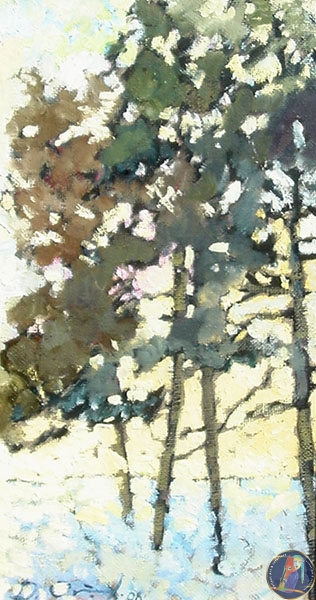
This evocative oil on canvas, measuring 23 x 45 cm, serves as a compelling early-career exploration by Mongolian artist Otgonbayar Khisheg. Painted in 2008—the same year it was showcased at the Beijing International Art Expo—the work reflects a sophisticated blend of Khisheg’s core styles: Realism, Nature, and Figurative art.
Visual Composition and Subject Matter
Despite the singular title, the painting is less about botanical documentation and more about the emotional architecture of the natural world. Khisheg employs a horizontal “panoramic” format, which creates a sense of expansive space even within a relatively intimate physical scale.
The Central Figure: The tree is rendered with the precision of a portrait. Rather than a generic landscape element, it is treated as a character with its own history. The gnarled textures of the bark and the delicate, deliberate placement of branches suggest a “figurative” approach to nature, giving the tree a skeletal, almost human-like posture.
Color Palette: The 2008 period of Khisheg’s work often features a grounded, earthy palette. Expect a harmony of deep umbers, sienna, and muted ochres, contrasted against a sky that likely utilizes subtle gradients to suggest the thin, crisp air characteristic of the Mongolian plateau.
Technique: Using the Oil on Canvas medium, the artist balances thin, glazed layers with more textured, impasto strokes in the foreground. This creates a tactile realism that invites the viewer to feel the ruggedness of the trunk against a soft, atmospheric background.
Style and Context
Born in Ulaanbaatar in 1986, Khisheg was only 22 when this piece was exhibited in Beijing. Tree acts as a bridge between his academic training in realism and his personal fascination with the spiritual endurance of the Mongolian landscape.
Key Characteristic: The painting avoids the “busy” clutter of traditional landscapes. By isolating the tree, Khisheg elevates it to a symbol of solitude and resilience, a recurring theme in Mongolian contemporary art.