
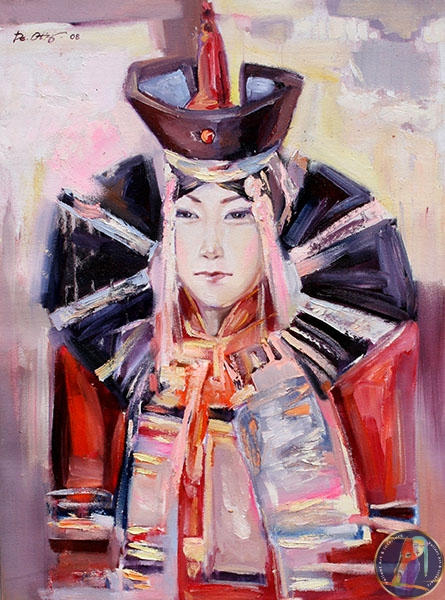
In Mongolian Queen 2, Otgonbayar Khisheg presents a striking portrait that blends historical grandeur with a soulful, contemporary realism. The composition is centered on a noblewoman, depicted from the chest up, whose presence commands the 70 x 50 cm canvas. The subject is framed against a soft, atmospheric background that suggests the vast, open horizons of the Mongolian steppe, though the focus remains intensely on her persona.
The Portraiture and Realism
Khisheg’s mastery of Figurative Realism is evident in the delicate rendering of the Queen’s features. Her gaze is steady and enigmatic, directed slightly away from the viewer, evoking a sense of quiet strength and introspection. The artist utilizes fine brushwork to capture:
Skin Tones: The luminous, warm quality of her complexion, highlighting the subtle play of light across her cheekbones.
Textural Contrast: The meticulous detail of her traditional attire, showcasing the interplay between heavy silks and intricate embroidery.
Symbolism and Attire
The “Queen” is adorned in traditional Mongolian regalia, which serves as a centerpiece for the work. Her Deel (traditional robe) and elaborate headpiece are rendered with sharp precision.
The Headpiece: A focal point of the painting, featuring ornate silverwork and turquoise or coral inlays, symbolic of high status and Mongolian heritage.
Cultural Identity: The painting acts as a bridge between the artist’s birth in Ulaanbaatar and the deep historical roots of the Mongol Empire, portraying the subject not just as a person, but as a vessel of national identity.
Color Palette and Light
The palette is dominated by rich, earthy tones juxtaposed with the vibrant blues or reds often found in Mongolian textiles. Khisheg employs a soft, naturalistic lighting—reminiscent of the “golden hour” on the grasslands—which softens the edges of the figure and integrates her seamlessly with the natural world.