
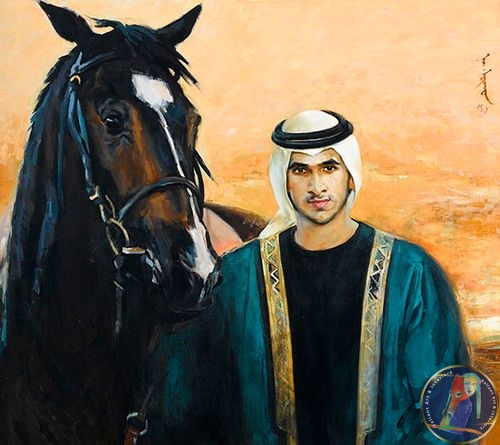
Son Of Sheik

Orkhon Namhaidagva , 2005 , Oil On Canvas

Son of Sheik is a compelling masterwork by the Mongolian artist Orkhon Namhaidagva, executed in 2005. The painting serves as a bridge between high-fidelity Photorealism and the soulful depth of traditional Portraiture. Measuring nearly a meter square, the canvas captures a moment of quiet intensity, focusing on the cultural identity and the personal gaze of its subject.

Composition and Subject Matter

The painting features a close-up portrait of a young man, presumably the titular “Son of Sheik.” Namhaidagva utilizes a tight, cinematic framing that forces the viewer into an intimate encounter with the subject.

  • The Gaze: The subject’s eyes are the focal point, rendered with such precision that they reflect a liquid clarity. There is a sense of “living presence” characteristic of the artist’s realist style, conveying a mixture of stoicism, youth, and inherited responsibility.

  • Textural Contrast: A hallmark of Namhaidagva’s technique is his ability to differentiate textures. The soft, matte quality of the skin is juxtaposed against the intricate folds and subtle sheen of the traditional headwear and garments.

Style and Technique

Drawing from his roots in Bulgan and his mastery of Realism, Namhaidagva employs a sophisticated layering of oil paints to achieve a hyper-realistic finish.

  • Lighting: The artist uses a directed light source that creates soft gradients of shadow across the subject’s face. This “Chiaroscuro” effect adds three-dimensional volume to the features, emphasizing the bone structure and the subtle nuances of expression.

  • Color Palette: The palette is grounded in earthy, organic tones—warm ambers, deep ochres, and muted creams. These colors evoke the desert landscape and traditional heritage while maintaining a contemporary, clean aesthetic.

  • Precision: Every detail, from the individual fibers of the fabric to the subtle pores of the skin, is rendered with a meticulousness that mirrors the clarity of a high-resolution photograph, yet retains the warmth and “hand” of a classical oil painting.
  • Orkhon Namhaidagva
  • Abstract, Figurative, Modern/Minimalist
  • Oil On Canvas
  • ORD/002
  • 95 x 105cm
  • Mongolian Art Gallery

Add Your Comment

Mongolian Art Gallery © 2025. All Rights Reserved
Privacy Policy / Terms of Use

Son of Sheik is a compelling masterwork by the Mongolian artist Orkhon Namhaidagva, executed in 2005. The painting serves as a bridge between high-fidelity Photorealism and the soulful depth of traditional Portraiture. Measuring nearly a meter square, the canvas captures a moment of quiet intensity, focusing on the cultural identity and the personal gaze of its subject.

Composition and Subject Matter

The painting features a close-up portrait of a young man, presumably the titular “Son of Sheik.” Namhaidagva utilizes a tight, cinematic framing that forces the viewer into an intimate encounter with the subject.

  • The Gaze: The subject’s eyes are the focal point, rendered with such precision that they reflect a liquid clarity. There is a sense of “living presence” characteristic of the artist’s realist style, conveying a mixture of stoicism, youth, and inherited responsibility.

  • Textural Contrast: A hallmark of Namhaidagva’s technique is his ability to differentiate textures. The soft, matte quality of the skin is juxtaposed against the intricate folds and subtle sheen of the traditional headwear and garments.

Style and Technique

Drawing from his roots in Bulgan and his mastery of Realism, Namhaidagva employs a sophisticated layering of oil paints to achieve a hyper-realistic finish.

  • Lighting: The artist uses a directed light source that creates soft gradients of shadow across the subject’s face. This “Chiaroscuro” effect adds three-dimensional volume to the features, emphasizing the bone structure and the subtle nuances of expression.

  • Color Palette: The palette is grounded in earthy, organic tones—warm ambers, deep ochres, and muted creams. These colors evoke the desert landscape and traditional heritage while maintaining a contemporary, clean aesthetic.

  • Precision: Every detail, from the individual fibers of the fabric to the subtle pores of the skin, is rendered with a meticulousness that mirrors the clarity of a high-resolution photograph, yet retains the warmth and “hand” of a classical oil painting.