

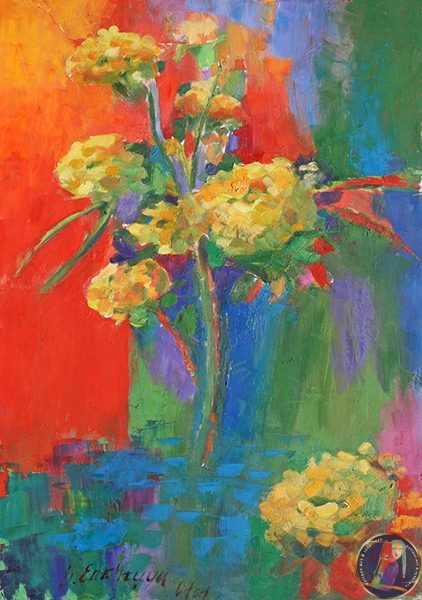
This 2008 oil on canvas serves as a compelling bridge between the artist’s Mongolian roots and the global language of contemporary abstraction. Standing at 70 x 50cm, the work reinterprets the traditional “still life” through a lens of emotive energy and fluid form.
Visual Composition and Style
While the title suggests a botanical subject, Byambasuren steers away from literal representation. The painting is characterized by:
Abstract Modernism: The “flower” is treated more as a focal point of energy than a biological specimen. The artist uses deconstructed shapes and sweeping brushstrokes to suggest growth and fragility without relying on rigid outlines.
Dynamic Textures: Utilizing the rich, slow-drying properties of oil paint, the work features layered applications that create a sense of depth. There is a visible tactile quality where the paint appears to have been pulled or scraped across the canvas, reflecting a modern, gestural approach.
Color Palette: Typical of Byambasuren’s early-career style, the color work likely balances the earthy, grounded tones of the Mongolian landscape with vibrant, contemporary accents that allow the central subject to “bloom” against a more muted or atmospheric background.
Artistic Context
Born in Ulaanbaatar in 1984, Enkhtuya Byambasuren belongs to a generation of Mongolian artists who emerged after the country’s transition to democracy. This allowed for a departure from Socialist Realism toward personal, abstract expression.
In Flower, we see the influence of this freedom. The painting doesn’t just depict an object; it captures a moment of transition. The 70 x 50cm vertical orientation gives the subject a “portrait” feel, elevating the simple flower to a position of singular importance and dignity.
