
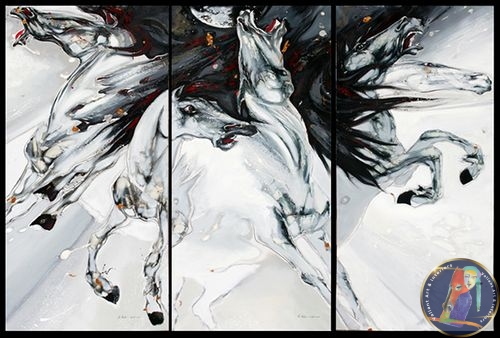
Black Triple Part is a commanding horizontal triptych-style composition that bridges the gap between Mongolian nomadic tradition and contemporary abstract expressionism. Despite the title’s emphasis on “Black,” the work is a sophisticated study of texture, depth, and the emotional weight of negative space.
Composition and Structure
The painting is characterized by its elongated aspect ratio ($70 \times 165 \text{ cm}$), creating a cinematic, panoramic view. The “Triple Part” refers to the visual division of the canvas into three distinct yet fluid segments. This structural choice evokes the feeling of a folding screen or the segmented views of the vast Mongolian steppe.
Color Palette and Texture
The Void: The dominant “black” is not a flat void but a rich, layered application of oil paint. Ochirbat utilizes varying densities of pigment to create a sense of infinite space, suggesting both the dark interior of a traditional ger (yurt) and the boundless night sky of the high plateau.
Contrasting Accents: Within the dark fields, the artist integrates subtle shifts in tone—deep umbers, charcoal grays, and perhaps flashes of muted earth tones—that emerge when caught by the light. These colors provide a rhythmic pulse across the three sections.
The Surface: True to his expressive style, the brushwork is visceral. Thick impasto strokes contrast with thinner, washed-out areas, giving the canvas a tactile, weathered quality that mimics natural elements like rock, charred wood, or ancient textiles.
Style and Symbolism
The painting exemplifies Ochirbat’s signature Contemporary Figurative Landscape Expressionism. While the work leans heavily into abstraction, there is a lingering “figurative” ghost within the forms—jagged lines and silhouettes that hint at mountain ranges, nomadic silhouettes, or ritualistic artifacts.
The use of black serves as a powerful metaphor for the “unknown” or the “unspoken” in Mongolian history and spirituality. By deconstructing the landscape into three parts, Ochirbat invites the viewer to move through the painting as a journey, where the darkness is not an absence of light, but a presence of profound depth and heritage.