
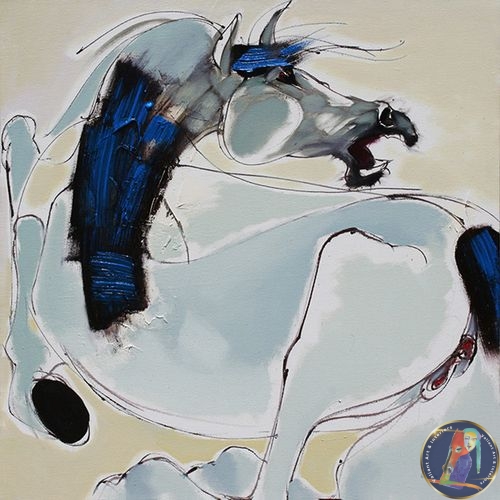
Horse Composition 3 (2009) is a masterful synthesis of Enkhtaivan Ochirbat’s Mongolian heritage and his distinctive flair for Abstract Expressionism. Measuring 70 x 70 cm, this oil on canvas piece transforms the traditional Mongolian subject of the horse into a dynamic study of energy, color, and movement.
Visual Composition and Style
The painting deviates from literal representation, leaning heavily into a Contemporary Figurative style. Rather than a static portrait, Ochirbat uses aggressive, sweeping brushstrokes to suggest the musculature and spirit of the horses.
The Subject: The “composition” likely features a cluster of equine forms that overlap and bleed into one another. The boundaries between the animals and the landscape are blurred, suggesting that the horses are an inseparable part of the Mongolian steppe.
The Palette: Given Ochirbat’s background and the “Expressionist” label, the colors are likely emotive rather than documentary. Expect a palette that balances earthy ochres and deep umbers with sudden flashes of vibrant color—perhaps a bold blue or a fiery crimson—used to highlight the “action” that defines his 2002–2004 exhibition series.
Texture: The oil medium is applied with varying thickness. You can sense the “Art Studio” influence here; the surface likely features a mix of smooth glazes and impasto textures that catch the light, giving the 70 x 70 cm square frame a sense of depth and physical weight.
Artistic Context
Created in 2009, this work represents Ochirbat in his prime as an educator and established artist. It sits at the intersection of his formal training (1993–1998) and his international exposure in the mid-2000s (America, Bulgaria, Poland).
The Theme of the Horse: For a Mongolian artist born in Ulaanbaatar, the horse is more than a subject—it is a symbol of freedom and national identity. In Horse Composition 3, the horse is stripped of its utility and reimagined as a force of nature.
Modernist Influence: The square format (70 x 70 cm) provides a balanced, modern “window” into a scene that feels chaotic and boundless. This tension between the structured frame and the wild, expressionist brushwork is a hallmark of Ochirbat’s style.