

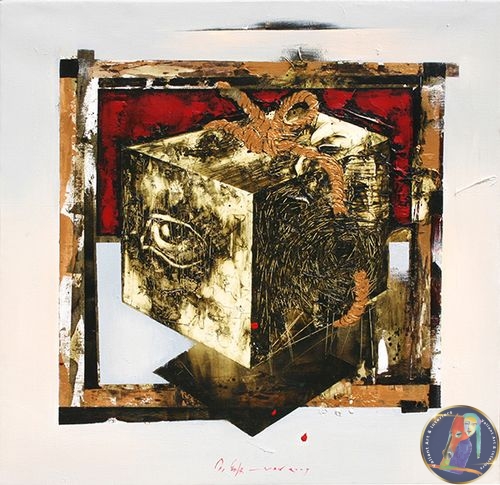
Composition (2009) is a compelling synthesis of Enkhtaivan Ochirbat’s diverse stylistic influences, merging the disciplined spatial awareness of his academic training with the raw, emotive power of Contemporary Expressionism. Measuring 86 x 86 cm, the square format of the canvas provides a balanced, contained stage for an otherwise high-energy exploration of form and color.
Visual Analysis
The painting lives at the intersection of Abstract Modernism and Figurative Landscape. While the title suggests a focus on pure arrangement, the work breathes with the atmospheric essence of the Mongolian steppe.
Color Palette: Ochirbat employs a sophisticated layering of oil pigments. The palette often leans into earthy ochres, deep ambers, and slate grays—evocative of Mongolia’s natural terrain—juxtaposed against sudden, sharp accents of primary colors or stark whites that disrupt the visual field.
Texture and Brushwork: Reflecting his experience in “Action” art exhibitions, the application of paint is tactile and vigorous. There is a visible tension between broad, sweeping palette knife strokes and delicate, agitated line work. This creates a sense of “living” space where the background and foreground bleed into one another.
Subject Matter: Though primarily abstract, the “Composition” hints at figurative elements. Ghostly silhouettes or structural fragments emerge and dissolve, suggesting the movement of horses, the geometry of traditional dwellings, or the shifting horizon lines of Ulaanbaatar’s outskirts.
Contextual Significance
Created during his tenure as a teacher at the “Industry and Art” school, this piece represents a mature phase in Ochirbat’s career. It bridges the gap between the traditional aesthetic values of the Union of Mongolian Artists and the global contemporary dialogue he engaged with during his exhibitions in the United States, Russia, and Europe.
In Composition, the artist moves beyond mere representation. He captures the internal landscape—the psychological weight of heritage meeting the friction of modern life. The 2009 work stands as a testament to his ability to translate the vastness of the Mongolian environment into a compact, square-meter window of intense emotional resonance.
