
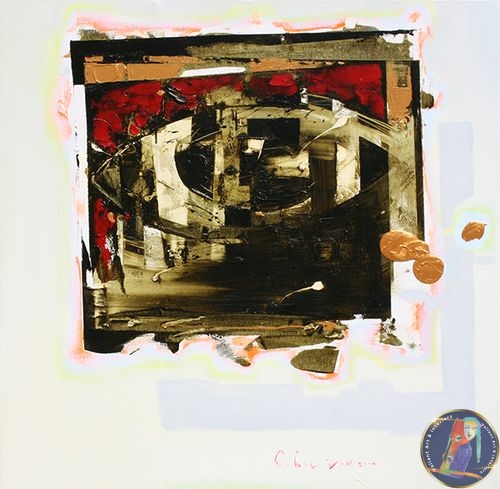
Composition (2009) is a masterful synthesis of Contemporary Expressionism and Modern Abstraction, reflecting the vast, spiritual energy of the Mongolian landscape through a square-format oil on canvas ($86 \times 86$ cm). Rather than depicting a literal scene, Ochirbat uses the canvas to explore the intersection of memory, tradition, and the raw elemental forces of his homeland.
Color Palette and Texture
The painting is defined by a sophisticated, layered application of oil paint. Ochirbat employs a palette that bridges the gap between earthy tradition and modern vibrancy:
Dominant Tones: Deep ochres, burnt sienna, and slate grays evoke the rugged terrain of the Mongolian steppe.
Accents: These grounded colors are often punctuated by sudden flashes of cerulean blue or madder red, suggesting the shifting light of a vast sky or the vibrant textiles of nomadic culture.
Technique: The texture is palpable; heavy impasto sections create a physical topography on the canvas, while thinner, translucent glazes allow light to “glow” from beneath the surface, giving the work a rhythmic, breathing quality.
Compositional Structure
As the title suggests, the work is an exercise in balance and formal arrangement. Despite its abstract nature, there is a distinct sense of horizontal grounding—a nod to the artist’s roots in landscape painting.
The Focal Point: Ochirbat often utilizes a central “core” of activity where shapes collide and bleed into one another. These forms are suggestive of nomadic structures, horses, or shifting weather patterns, yet they remain fluid and non-representational.
Space: The square dimensions ($86 \times 86$ cm) provide a sense of stability and containment, forcing the viewer’s eye to move inward toward the dense, expressive heart of the piece rather than wandering off the edges.