
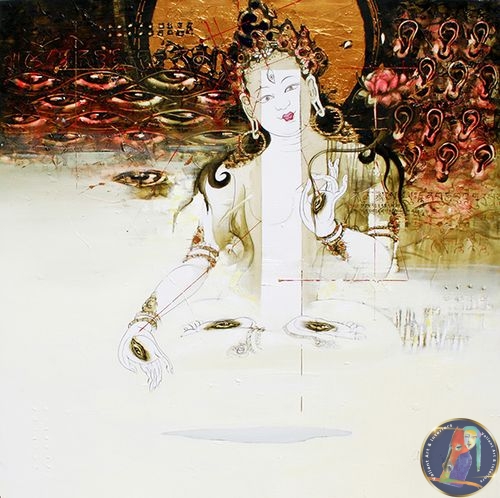
White Buddha

Enkhtaivan Ochirbat , 2009 , Oil On Canvas

“White Buddha” is a commanding, large-scale square composition that bridges the gap between Contemporary Figurative art and Abstract Expressionism. True to Enkhtaivan Ochirbat’s Mongolian heritage and his stylistic fluidity, the painting presents a meditative yet raw interpretation of spiritual serenity. The central figure of the Buddha emerges not through precise anatomical lines, but through a textured, ethereal layering of paint that suggests a presence rather than a physical body.

Composition and Style

The 150 x 150 cm canvas provides an expansive space that mirrors the vastness of the Mongolian landscape, a common theme in the artist’s work. The “White Buddha” occupies the central axis, though its silhouette is softened and blurred, blending into the surrounding atmosphere.

  • Color Palette: Dominated by shades of titanium white, ivory, and cool greys, the painting utilizes a “high-key” palette. This creates an effect of blinding spiritual light or a figure appearing through a thick mountain mist. Subtle undertones of earth tones—ochre or faint blue—may peek through the layers, grounding the ethereal subject.

  • Brushwork: Ochirbat employs an Expressionist technique, likely using palette knives or broad, sweeping brushstrokes to build physical texture. The application of oil is thick and tactile, giving the “White Buddha” a sculptural quality that catches the light differently depending on the viewer’s angle.

Symbolism and Interpretation

Created in 2009, this work reflects the artist’s dual life as a teacher and a creator. The choice of “white” symbolizes purity, emptiness (Sunyata), and the transcendence of the ego.

By stripping away the traditional iconography—such as detailed robes or specific mudras—Ochirbat focuses on the essence of enlightenment. The abstraction suggests that the Buddha is not a historical figure trapped in the past, but an atmospheric force integrated into the modern world. The square format of the canvas provides a sense of perfect balance and stability, reinforcing the theme of inner peace.

  • Enkhtaivan Ochirbat
  • Abstract, Realism, Surrealism
  • Oil On Canvas
  • ENT21/035
  • 150 x 150cm
  • Mongolian Art Gallery

Add Your Comment

Mongolian Art Gallery © 2025. All Rights Reserved
Privacy Policy / Terms of Use

“White Buddha” is a commanding, large-scale square composition that bridges the gap between Contemporary Figurative art and Abstract Expressionism. True to Enkhtaivan Ochirbat’s Mongolian heritage and his stylistic fluidity, the painting presents a meditative yet raw interpretation of spiritual serenity. The central figure of the Buddha emerges not through precise anatomical lines, but through a textured, ethereal layering of paint that suggests a presence rather than a physical body.

Composition and Style

The 150 x 150 cm canvas provides an expansive space that mirrors the vastness of the Mongolian landscape, a common theme in the artist’s work. The “White Buddha” occupies the central axis, though its silhouette is softened and blurred, blending into the surrounding atmosphere.

  • Color Palette: Dominated by shades of titanium white, ivory, and cool greys, the painting utilizes a “high-key” palette. This creates an effect of blinding spiritual light or a figure appearing through a thick mountain mist. Subtle undertones of earth tones—ochre or faint blue—may peek through the layers, grounding the ethereal subject.

  • Brushwork: Ochirbat employs an Expressionist technique, likely using palette knives or broad, sweeping brushstrokes to build physical texture. The application of oil is thick and tactile, giving the “White Buddha” a sculptural quality that catches the light differently depending on the viewer’s angle.

Symbolism and Interpretation

Created in 2009, this work reflects the artist’s dual life as a teacher and a creator. The choice of “white” symbolizes purity, emptiness (Sunyata), and the transcendence of the ego.

By stripping away the traditional iconography—such as detailed robes or specific mudras—Ochirbat focuses on the essence of enlightenment. The abstraction suggests that the Buddha is not a historical figure trapped in the past, but an atmospheric force integrated into the modern world. The square format of the canvas provides a sense of perfect balance and stability, reinforcing the theme of inner peace.