
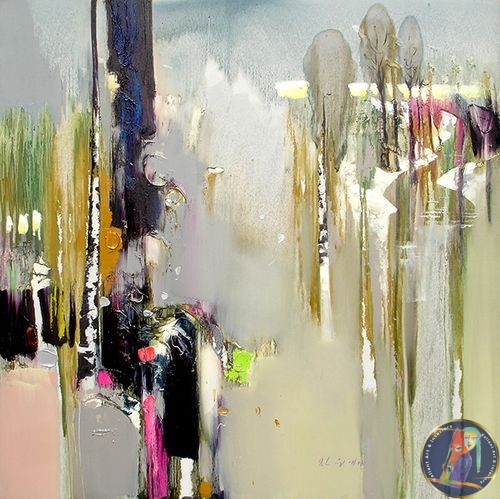
Enkhtaivan Ochirbat’s 2008 work, Spring, is a compelling synthesis of his Mongolian roots and his mastery of contemporary figurative expressionism. Executed in oil on a square $92 \times 92$ cm canvas, the painting captures the transitional energy of the season through a lens that is both deeply personal and culturally resonant.
Composition and Style
The painting sits at the intersection of Abstract Modernism and Expressionist Landscape. Rather than a literal depiction of a Mongolian steppe thawing, Ochirbat uses a tactile, layered approach to evoke the feeling of spring.
The Square Format: The $92 \times 92$ cm dimensions provide a balanced, grounded stage for a composition that is otherwise fluid and dynamic.
Brushwork: Reflecting his background in the “Art studio” and his academic training, the brushwork is likely bold and impasto-heavy. There is a palpable sense of movement—perhaps mimicking the harsh winds of the Mongolian plateau giving way to softer breezes.
Figurative Elements: While the piece leans into abstraction, subtle figurative elements (likely livestock or nomadic structures) are often woven into the texture, suggesting a landscape that is lived-in and ancient.
Color Palette and Atmosphere
True to the “Spring” theme seen throughout his exhibition history (1998–2005), the palette for this 2008 piece likely moves away from the stark whites of winter toward a more complex range:
The Thaw: Muted earth tones—ochre, raw sienna, and deep umber—represent the emerging ground.
New Life: These are punctuated by “action” colors—flashes of verdant green, pale cerulean, or even a sudden warmth of yellow—signifying the rapid bloom characteristic of the Central Asian climate.
Light: There is a luminosity to the oil medium here that suggests the high-altitude sun reflecting off remaining patches of snow or meltwater.