
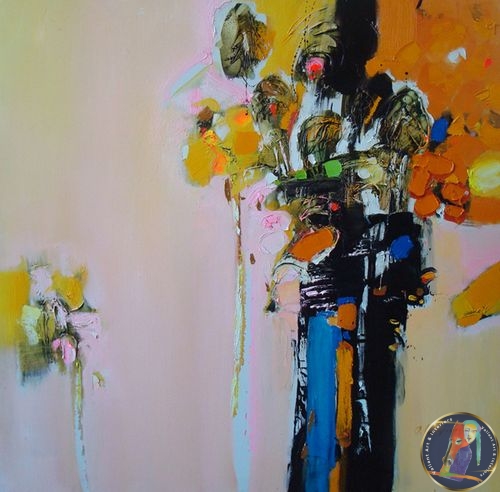
In Autumn, Enkhtaivan Ochirbat leverages his background in the Abstract Modern and Contemporary Figurative movements to create a piece that feels both grounded in the Mongolian landscape and untethered by literal representation. The square format ($92 \times 92\text{ cm}$) provides a balanced, stable frame that focuses the viewer’s attention on the interplay of texture and color rather than a traditional horizon line.
The painting is a masterful display of Expressionist landscape. Rather than a photographic depiction of a season, Ochirbat captures the energy of the Mongolian autumn. The application of oil paint is likely thick and gestural, suggesting the “Action” style influences noted in his exhibition history.
Color Palette and Atmosphere
True to its title, the work is dominated by a rich, evocative palette:
Primary Tones: Deep ochres, burnt oranges, and brilliant golds represent the changing grasslands or “steppe” foliage.
Contrasting Accents: Ochirbat often incorporates cool counterpoints—perhaps flashes of steely blue or muted greys—to signify the encroaching winter chill typical of the Ulaanbaatar region.
Depth: The artist uses the luminosity of oil paint to create a sense of “inner light,” where the colors seem to glow from within the canvas, mimicking the low, golden sun of a late September afternoon.
Thematic Context
As an artist who has spent his life in Ulaanbaatar, Ochirbat’s work is deeply rhythmic. Having participated in the Union of Mongolian Artists’ “Spring” and “Autumn” exhibitions for nearly a decade prior to this piece, Autumn represents a mature refinement of his favorite themes.
The painting bridges the gap between the traditional nomadic appreciation of nature and the modern art education Ochirbat received in the late 90s. There is a sense of movement in the brushwork that mirrors the wind across the high plains, transforming a static landscape into a living, breathing entity.