
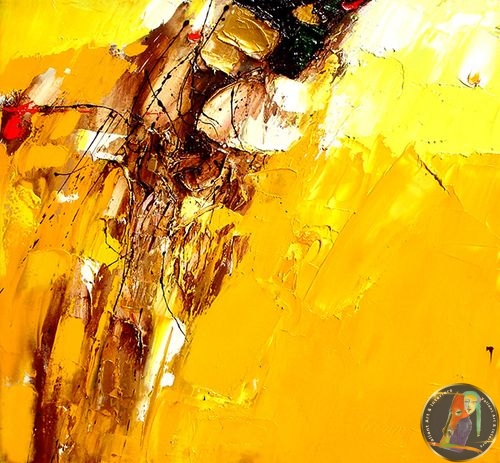
Composition 15 is a masterful 45 x 45cm oil on canvas that serves as a bridge between Enkhtaivan Ochirbat’s Mongolian heritage and the broader language of global contemporary abstraction. Created in 2008, this piece encapsulates the artist’s transition from academic training to a more liberated, expressionist style.
Visual Analysis and Style
The painting is characterized by a dense, tactile surface where the physical application of oil paint becomes as important as the subject itself. True to Ochirbat’s background in Contemporary Figurative Landscape, the work likely avoids pure abstraction in favor of “felt” environments.
Color Palette: Given the artist’s frequent participation in exhibitions like “Color” and “Autumn,” this piece likely utilizes a sophisticated interplay of earthy ochres, deep ambers, and sudden shocks of vibrant pigment. The 2008 period of his work often featured a dialogue between the vast, monochromatic stillness of the Mongolian steppe and intense, localized bursts of energy.
Compositional Structure: Despite its square format, the “Composition” series focuses on internal balance. Ochirbat uses Expressionist brushwork—thick impasto and sweeping strokes—to create a sense of movement. There is a rhythmic quality to the marks, suggesting the wind-swept terrain of Bayangol or the spiritual weight of Ulaanbaatar’s history.
Artistic Context
To understand Composition 15, one must look at the artist’s trajectory:
The Academic Foundation: His education (1993-1998) provided the structural discipline seen in the painting’s balance, while his tenure as an art teacher at the “Industry and Art” school informs the technical precision of his medium handling.
Cultural Synthesis: By 2008, Ochirbat had exhibited internationally in Russia, America, Bulgaria, and Poland. Composition 15 reflects this “Action”-oriented phase (referencing his “Action” 2, 3, 4 exhibitions), where the act of painting becomes a performance of identity.
Interpretation
The painting functions as a psychological map. It strips away the literal “horse” or “treasure” (themes explored in his 2004 American exhibition) to find the Abstract Modern essence of those subjects. It is a work of controlled chaos—where the artist’s Mongolian roots meet the visceral, emotive demands of modern expressionism. In this small 45 x 45cm window, the viewer encounters a landscape that is not just seen, but inhabited.