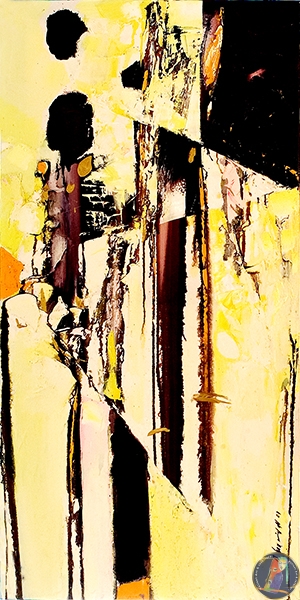
Yellow Composition 1-2

Enkhtaivan Ochirbat , 2008 , Oil On Canvas

Yellow Composition 1-2 is a compelling exploration of light, texture, and the vast Mongolian horizon, rendered in oil on a horizontal $46 \times 92$ cm canvas. Created in 2008, this work serves as a bridge between Ochirbat’s formal training at the Art Institute and his evolving mastery of Contemporary Figurative Expressionism.

Visual Breakdown

The painting is dominated by a radiant, tonal exploration of yellow, which functions less as a mere color and more as a representation of atmospheric energy.

  • Composition and Perspective: The wide, panoramic format emphasizes the expansive nature of the Mongolian landscape. Ochirbat utilizes a minimalist spatial arrangement, where the traditional “ground” and “sky” are blurred through expressive brushwork. The composition is balanced but dynamic, guiding the viewer’s eye across the canvas through shifts in saturation and texture rather than literal landmarks.

  • Color Palette: True to its title, the work is a study in monochromatic complexity. The yellows range from deep, earthy ochres and ambers to bright, ethereal lemons. These are occasionally punctuated by subtle, muted undertones—perhaps whispers of grey or sienna—that provide the necessary depth to prevent the composition from feeling flat.

  • Texture and Technique: Ochirbat’s background in “Action” exhibitions is evident in the tactile quality of the oil paint. There is a palpable sense of movement; the paint is applied with varied intensity, featuring both smooth, glazed passages and more aggressive, impasto strokes. This technique creates a “vibrating” effect, mimicking the shimmering heat of a steppe or the spiritual glow of a sun-drenched memory.


Style and Context

The painting sits at the intersection of Abstract Modernism and Contemporary Figurative Landscape. While the “subject” may appear abstract, the emotional weight and the horizontal orientation evoke the specific spirit of Ulaanbaatar’s surroundings.

“Yellow Composition 1-2 does not just depict a scene; it captures the ‘essence’ of light as it interacts with the Mongolian identity.”

Ochirbat’s role as an art teacher since 2002 is reflected in the technical precision of the piece. Having exhibited internationally—from the “Treasure and Horses” exhibition in America to showcases in Poland and Bulgaria—this work represents a period where the artist was successfully translating his local heritage into a universal, abstract language.

In this composition, the viewer finds a balance between the disciplined structure of his 1993–1998 institute training and the raw, expressive freedom found in his later “Action” series. It is a quiet yet powerful testament to the light of the East.
  • Enkhtaivan Ochirbat
  • Sculpture, Surrealism
  • Oil On Canvas
  • ENT21/024
  • 46 x 92 Cm
  • Mongolian Art Gallery

Add Your Comment

Mongolian Art Gallery © 2025. All Rights Reserved
Privacy Policy / Terms of Use

Yellow Composition 1-2 is a compelling exploration of light, texture, and the vast Mongolian horizon, rendered in oil on a horizontal $46 \times 92$ cm canvas. Created in 2008, this work serves as a bridge between Ochirbat’s formal training at the Art Institute and his evolving mastery of Contemporary Figurative Expressionism.

Visual Breakdown

The painting is dominated by a radiant, tonal exploration of yellow, which functions less as a mere color and more as a representation of atmospheric energy.

  • Composition and Perspective: The wide, panoramic format emphasizes the expansive nature of the Mongolian landscape. Ochirbat utilizes a minimalist spatial arrangement, where the traditional “ground” and “sky” are blurred through expressive brushwork. The composition is balanced but dynamic, guiding the viewer’s eye across the canvas through shifts in saturation and texture rather than literal landmarks.

  • Color Palette: True to its title, the work is a study in monochromatic complexity. The yellows range from deep, earthy ochres and ambers to bright, ethereal lemons. These are occasionally punctuated by subtle, muted undertones—perhaps whispers of grey or sienna—that provide the necessary depth to prevent the composition from feeling flat.

  • Texture and Technique: Ochirbat’s background in “Action” exhibitions is evident in the tactile quality of the oil paint. There is a palpable sense of movement; the paint is applied with varied intensity, featuring both smooth, glazed passages and more aggressive, impasto strokes. This technique creates a “vibrating” effect, mimicking the shimmering heat of a steppe or the spiritual glow of a sun-drenched memory.


Style and Context

The painting sits at the intersection of Abstract Modernism and Contemporary Figurative Landscape. While the “subject” may appear abstract, the emotional weight and the horizontal orientation evoke the specific spirit of Ulaanbaatar’s surroundings.

“Yellow Composition 1-2 does not just depict a scene; it captures the ‘essence’ of light as it interacts with the Mongolian identity.”

Ochirbat’s role as an art teacher since 2002 is reflected in the technical precision of the piece. Having exhibited internationally—from the “Treasure and Horses” exhibition in America to showcases in Poland and Bulgaria—this work represents a period where the artist was successfully translating his local heritage into a universal, abstract language.

In this composition, the viewer finds a balance between the disciplined structure of his 1993–1998 institute training and the raw, expressive freedom found in his later “Action” series. It is a quiet yet powerful testament to the light of the East.