
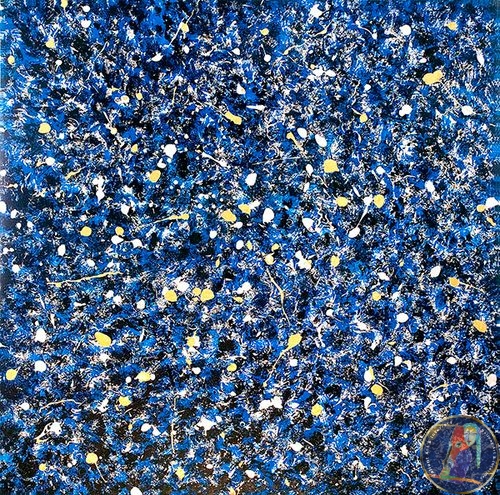
Enkhtaivan Ochirbat’s “Composition” (2008) is a masterful synthesis of the artist’s diverse stylistic influences, bridging the gap between contemporary figurative landscape and abstract expressionism. Measuring 92 x 92 cm, the square format provides a balanced, stable stage for what is an otherwise dynamic and fluid exploration of color and form.
Aesthetic Style and Visual Language
Given Ochirbat’s background in the Ulaanbaatar art scene and his association with Abstract Modernism, “Composition” likely moves away from literal representation toward an emotional or atmospheric interpretation of the Mongolian landscape.
Color Palette: Drawing from his “Color” exhibition era, the work likely features a bold, sophisticated palette. Expect a dialogue between the earthy tones of the Mongolian steppe—ochres, deep reds, and siennas—contrasted against cooler, expansive blues or teals that suggest the “Eternal Blue Sky.”
Brushwork: As an Expressionist, Ochirbat utilizes visible, energetic brushstrokes. The oil medium is likely applied with varying thickness, from translucent glazes that provide depth to impasto moments that give the canvas a physical, tactile presence.
Themes and Interpretation
The title “Composition” suggests a focus on the formal qualities of painting—line, shape, and rhythm—rather than a specific narrative. However, his identity as a Contemporary Figurative Landscape artist often shines through in the structural arrangement:
Spatial Harmony: The 2008 period in Ochirbat’s career often involved deconstructing traditional scenery into geometric or fluid segments. You might see the horizon line blurred or tilted, inviting the viewer to experience the feeling of a place rather than a photographic likeness.
The “Action” Influence: Having participated in the “Action” exhibition series shortly before this piece was created, there is a sense of movement in the work. The “Composition” isn’t static; it captures the wind of the plains or the shifting light of the high altitude.
Contextual Significance
Created during his tenure as an art teacher at the “Industry and Art” school, this painting represents a mature phase of Ochirbat’s career. It reflects a shift from his early Russian-influenced training toward a more global, modern aesthetic that helped bring Mongolian contemporary art to international audiences in America, Bulgaria, and Poland.
In “Composition,” the artist successfully translates the vastness of his heritage into a language of universal abstraction, making it a pivotal example of his mid-career exploration of texture and spatial balance.