
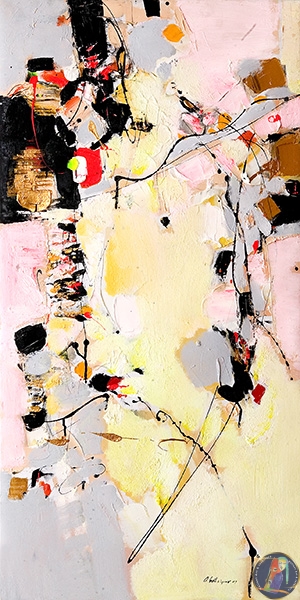
Composition 9 is a compelling manifestation of Enkhtaivan Ochirbat’s signature fusion of Contemporary Figurative Landscape and Abstract Expressionism. Painted in 2008, this oil on canvas utilizes an elongated horizontal format ($46 \times 92\text{cm}$), a choice that naturally evokes the vast, panoramic stretches of the Mongolian steppe, even when the subject matter leans toward the abstract.
Visual Breakdown and Style
Color Palette: The work is defined by a sophisticated interplay of earthy tones and vibrant, emotive strikes. Ochirbat often employs deep ochres, burnt sienna, and slate grays to ground the piece in a “Mongolian” color profile, while injecting sudden bursts of cerulean blue or stark white to represent light, water, or the spiritual “Blue Sky” tradition of his heritage.
Brushwork and Texture: Reflecting his training and his role as an art educator, the brushwork in Composition 9 is both disciplined and visceral. The paint is applied with varying thickness—from thin, translucent washes that suggest atmospheric haze to heavy, impasto strokes that give the canvas a tactile, rugged energy.
The “Figurative Landscape” Element: While the title suggests a purely formalist approach (a “composition”), the artist’s roots are visible. The shapes within the painting often hint at horizon lines, rocky outcroppings, or perhaps the fleeting silhouettes of horses—a recurring motif in his 2004 “Treasure and Horses” period—dissolving into a sea of gestural abstraction.
Context and Artistic Intent
Produced during a prolific period following his international exhibitions in America, Bulgaria, and Poland, Composition 9 represents Ochirbat at a point of high technical maturity.
“His work acts as a bridge between the traditional nomadic consciousness and the rapid urbanization of post-1990 Mongolia.”
By moving away from literal representation, Ochirbat uses the Abstract Modern style to capture the feeling of the Mongolian landscape rather than a photographic likeness. The 2008 piece stands as a testament to his ability to translate the vastness of his birthplace into a balanced, rhythmic arrangement of form and color, proving why he has remained a steady influence in the “Industry and Art” academic circle for decades.