
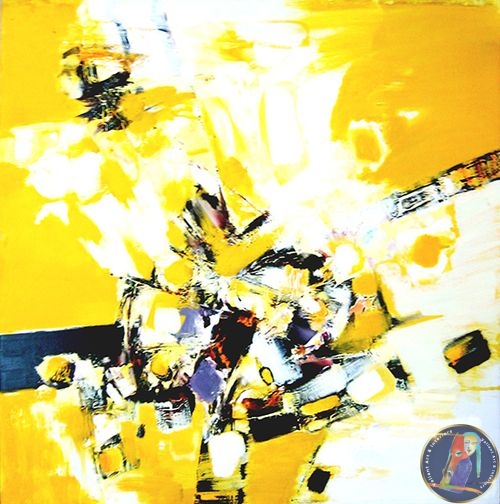
Composition 8

Enkhtaivan Ochirbat , 2005 , Oil On Canvas

Composition 8 is a sophisticated exploration of the Mongolian landscape through the lens of Abstract Expressionism. Created during a pivotal year in Ochirbat’s career—coinciding with his international exhibitions in Europe and Korea—this square-format canvas moves away from literal representation to capture the “spirit” of the terrain.

Color Palette and Texture

The painting is defined by a rich, earthy palette that reflects the artist’s roots in Ulaanbaatar. Dominant tones include:

  • Ochre and Terracotta: Suggesting the rugged soil and sun-drenched plains of the steppe.

  • Deep Indigo and Slate: Providing structural depth and hints of a distant, moody horizon.

  • Ephemeral Whites and Grays: Applied with varying opacity to mimic the shifting light or low-hanging mist characteristic of the Mongolian highlands.

Ochirbat utilizes a heavy impasto technique, where the oil paint is applied thickly, possibly with a palette knife. This creates a tactile, topographical surface that makes the painting feel like a physical extension of the earth itself.

Composition and Style

True to his background in the “Action” exhibition series (2002–2004), the work is marked by dynamic energy. While the piece is titled “Composition,” it retains the skeletal structure of a Figurative Landscape.

  • Vertical vs. Horizontal: The 92 x 92 cm frame is balanced by strong horizontal sweeps that suggest vastness, interrupted by sharp, vertical “scratches” or gestural marks. These marks act as visual anchors, reminiscent of ancient stelae or the silhouettes of distant structures.

  • Emotional Resonance: The style sits at the intersection of Contemporary Expressionism and traditional Mongolian aesthetics. There is a sense of controlled chaos—a reflection of the artist’s dual role as a disciplined art teacher and a progressive, experimental painter.

Artistic Context

Produced in 2005, this piece represents Ochirbat at a high point of professional visibility. Having transitioned from a commercial artist at “Art Studio” to a formal educator, Composition 8 showcases a mastery of formal elements (balance, rhythm, and texture) while pushing the boundaries of Mongolian modern art. It serves as a bridge between the physical reality of his homeland and the internal, emotive world of the artist.

  • Enkhtaivan Ochirbat
  • Photorealism, Sculpture
  • Oil On Canvas
  • ENT21/008
  • 92 x 92cm
  • Mongolian Art Gallery

Add Your Comment

Mongolian Art Gallery © 2025. All Rights Reserved
Privacy Policy / Terms of Use

Composition 8 is a sophisticated exploration of the Mongolian landscape through the lens of Abstract Expressionism. Created during a pivotal year in Ochirbat’s career—coinciding with his international exhibitions in Europe and Korea—this square-format canvas moves away from literal representation to capture the “spirit” of the terrain.

Color Palette and Texture

The painting is defined by a rich, earthy palette that reflects the artist’s roots in Ulaanbaatar. Dominant tones include:

  • Ochre and Terracotta: Suggesting the rugged soil and sun-drenched plains of the steppe.

  • Deep Indigo and Slate: Providing structural depth and hints of a distant, moody horizon.

  • Ephemeral Whites and Grays: Applied with varying opacity to mimic the shifting light or low-hanging mist characteristic of the Mongolian highlands.

Ochirbat utilizes a heavy impasto technique, where the oil paint is applied thickly, possibly with a palette knife. This creates a tactile, topographical surface that makes the painting feel like a physical extension of the earth itself.

Composition and Style

True to his background in the “Action” exhibition series (2002–2004), the work is marked by dynamic energy. While the piece is titled “Composition,” it retains the skeletal structure of a Figurative Landscape.

  • Vertical vs. Horizontal: The 92 x 92 cm frame is balanced by strong horizontal sweeps that suggest vastness, interrupted by sharp, vertical “scratches” or gestural marks. These marks act as visual anchors, reminiscent of ancient stelae or the silhouettes of distant structures.

  • Emotional Resonance: The style sits at the intersection of Contemporary Expressionism and traditional Mongolian aesthetics. There is a sense of controlled chaos—a reflection of the artist’s dual role as a disciplined art teacher and a progressive, experimental painter.

Artistic Context

Produced in 2005, this piece represents Ochirbat at a high point of professional visibility. Having transitioned from a commercial artist at “Art Studio” to a formal educator, Composition 8 showcases a mastery of formal elements (balance, rhythm, and texture) while pushing the boundaries of Mongolian modern art. It serves as a bridge between the physical reality of his homeland and the internal, emotive world of the artist.