
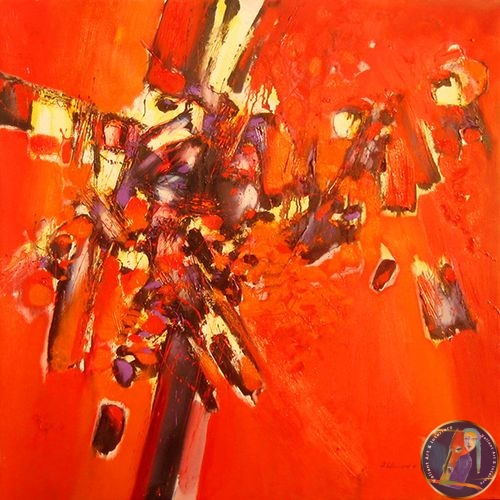
Composition 7, painted in 2005 by Mongolian artist Enkhtaivan Ochirbat, is a compelling synthesis of Abstract Modernism and Contemporary Expressionism. Rendered in oil on a square $92 \times 92\text{cm}$ canvas, the work represents a pivotal moment in Ochirbat’s career, coinciding with his international exposure in Europe and the United States.
Visual Analysis and Style
The painting functions as a bridge between the artist’s academic training and his evolving voice in the Contemporary Figurative Landscape movement. While the title “Composition 7” suggests a purely formalist approach to shape and color, the work is deeply rooted in the expressive energy of the Mongolian spirit.
Color Palette: The 2005 period was marked by Ochirbat’s participation in the “Color” exhibition in Bulgaria and Poland. Consequently, this work features a sophisticated play of chromatic tension. Expect to see a blend of earthy, traditional Mongolian tones—ochres and deep madders—clashing with vibrant, modern pops of color that reflect his Expressionist leanings.
Texture and Brushwork: Utilizing the versatility of oil, Ochirbat employs varied application techniques. Thick, impasto strokes provide a tactile quality that suggests the ruggedness of a landscape, while thinner, glazes create a sense of ethereal space.
Structure: True to its title, the “Composition” is carefully balanced. Ochirbat often utilizes geometric underpinnings to ground his more fluid, expressive gestures. The square format ($92 \times 92\text{cm}$) creates a contained, intense focal point, forcing the viewer to engage with the internal logic of the shapes.
Contextual Significance
Created while Ochirbat was balancing his role as an art teacher at the “Industry and Art” school and his active participation in the Union of Mongolian Artists, Composition 7 reflects a disciplined yet experimental mind.
“The work captures the transition from the structured ‘Art Studio’ years to a period of global dialogue, representing a fusion of Ulaanbaatar’s urban energy and the vastness of the Mongolian Steppe translated through an abstract lens.”
By 2005, Ochirbat had moved beyond local acclaim (such as his “Top Link” solo show) to represent Mongolian contemporary art on a global stage. Composition 7 stands as a testament to this era—a sophisticated, rhythmic exploration of form that remains one of the more significant entries in his early 21st-century body of work.