

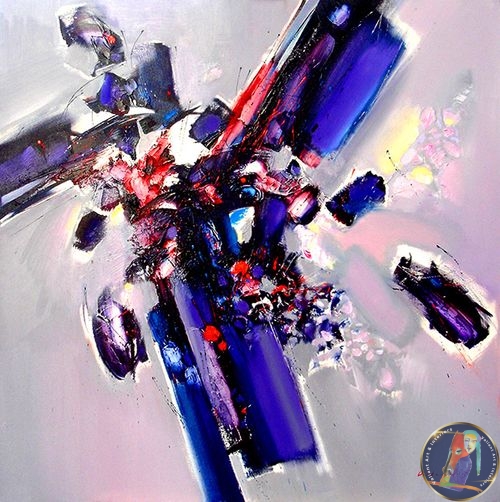
Composition 4 is a compelling oil-on-canvas work that serves as a bridge between Enkhtaivan Ochirbat’s formal academic training and his evolution into Abstract Expressionism. Measuring 92 x 92 cm, the square format provides a balanced, contained stage for a visual language that is both energetic and deeply rooted in the Mongolian landscape.
Visual Analysis and Style
The painting is a masterclass in Contemporary Figurative Landscape, where the literal world is distilled into emotional resonance. While the title suggests a lean toward pure abstraction, the work retains the ghostly “memory” of a horizon, a hallmark of Ochirbat’s style.
Color Palette: Created during his 2005 “Color” exhibition period, the work likely utilizes a sophisticated interplay of earthy ochres and deep blues, contrasted against sudden bursts of high-chroma pigments. These colors reflect the stark, shifting light of the Mongolian steppe.
Brushwork: The application of oil is visceral and gestural. Ochirbat employs thick, expressive strokes that suggest movement—the rushing of wind or the galloping of horses—without explicitly depicting them. The influence of his “Action” exhibition series (2002–2004) is evident in the rhythmic, almost physical texture of the paint.
Balance of Form: There is a tension between the Abstract Modern structure and Expressionist freedom. The composition is grounded by heavy, darker masses at the base, which give way to lighter, more atmospheric treatments toward the top, mimicking the vastness of the sky.
Context and Influence
Produced in 2005—a pivotal year that saw Ochirbat exhibiting internationally in Bulgaria, Poland, and South Korea—Composition 4 represents the artist at a point of high creative confidence.
As an art teacher at the “Industry and Art” school during this period, his work reflects a rigorous understanding of color theory balanced with a desire to break away from traditional representation. The painting does not just depict a place; it depicts the feeling of a place, utilizing the square canvas to trap a specific moment of atmospheric intensity. It stands as a testament to the “Top Link” of Mongolian contemporary art, merging nomadic heritage with global modernism.
