
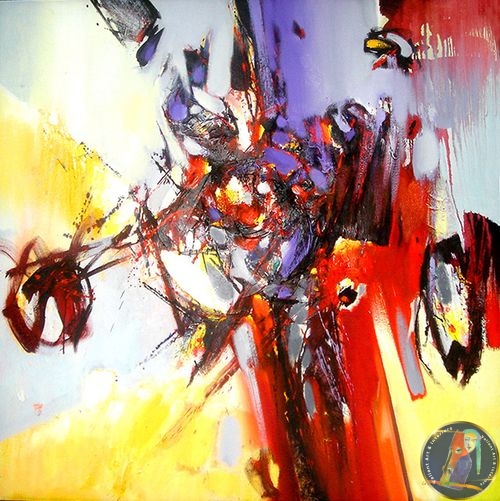
Composition 5

Enkhtaivan Ochirbat , 2005 , Oil On Canvas

Composition 5 is a captivating square-format oil painting ($92 \times 92\text{cm}$) that serves as a bridge between Enkhtaivan Ochirbat’s Mongolian heritage and the fluid energy of Contemporary Expressionism. Created in 2005, a year marked by the artist’s international exposure in Europe and Korea, the work reflects a sophisticated mastery of “Contemporary Figurative Landscape.”

Visual Analysis and Composition

The painting is characterized by a high-energy, Abstract Modern aesthetic that avoids rigid lines in favor of rhythmic, gestural brushwork. While the title “Composition” suggests a lean toward pure abstraction, the viewer can discern the ghostly, expressive silhouettes of figures and natural elements—likely horses or nomadic travelers—emerging from a haze of atmospheric color.

  • Color Palette: The work utilizes a rich, earthy foundation punctuated by vibrant, emotive strikes. Ochirbat often employs deep ambers, scorched siennas, and slate blues to evoke the expansive Mongolian steppe, but allows for bursts of primary colors that suggest movement and light.

  • Texture and Technique: The oil paint is applied with varied density. In some areas, the pigment is thin and translucent, creating a sense of vast, receding space. In others, thick impasto strokes provide a tactile, physical presence that mirrors the ruggedness of the Central Asian landscape.

  • Dynamic Flow: True to the Expressionist style, the composition is not static. There is a circular or diagonal tension within the 92cm square frame, drawing the eye toward a central “heart” of activity where forms collide and dissolve.

Context and Spirit

Given Ochirbat’s background and his role as an art teacher in Ulaanbaatar, Composition 5 represents a period of intense creative synthesis. It captures the “action” (referencing his Action exhibition series) of a nation in transition. The painting does not merely depict a scene; it captures the feeling of the Mongolian wind, the dust of the plains, and the spiritual weight of history filtered through a modern, global lens.
  • Enkhtaivan Ochirbat
  • Photorealism, Sculpture
  • Oil On Canvas
  • ENT21/005
  • 92 x 92cm
  • Mongolian Art Gallery

Add Your Comment

Mongolian Art Gallery © 2025. All Rights Reserved
Privacy Policy / Terms of Use

Composition 5 is a captivating square-format oil painting ($92 \times 92\text{cm}$) that serves as a bridge between Enkhtaivan Ochirbat’s Mongolian heritage and the fluid energy of Contemporary Expressionism. Created in 2005, a year marked by the artist’s international exposure in Europe and Korea, the work reflects a sophisticated mastery of “Contemporary Figurative Landscape.”

Visual Analysis and Composition

The painting is characterized by a high-energy, Abstract Modern aesthetic that avoids rigid lines in favor of rhythmic, gestural brushwork. While the title “Composition” suggests a lean toward pure abstraction, the viewer can discern the ghostly, expressive silhouettes of figures and natural elements—likely horses or nomadic travelers—emerging from a haze of atmospheric color.

  • Color Palette: The work utilizes a rich, earthy foundation punctuated by vibrant, emotive strikes. Ochirbat often employs deep ambers, scorched siennas, and slate blues to evoke the expansive Mongolian steppe, but allows for bursts of primary colors that suggest movement and light.

  • Texture and Technique: The oil paint is applied with varied density. In some areas, the pigment is thin and translucent, creating a sense of vast, receding space. In others, thick impasto strokes provide a tactile, physical presence that mirrors the ruggedness of the Central Asian landscape.

  • Dynamic Flow: True to the Expressionist style, the composition is not static. There is a circular or diagonal tension within the 92cm square frame, drawing the eye toward a central “heart” of activity where forms collide and dissolve.

Context and Spirit

Given Ochirbat’s background and his role as an art teacher in Ulaanbaatar, Composition 5 represents a period of intense creative synthesis. It captures the “action” (referencing his Action exhibition series) of a nation in transition. The painting does not merely depict a scene; it captures the feeling of the Mongolian wind, the dust of the plains, and the spiritual weight of history filtered through a modern, global lens.