
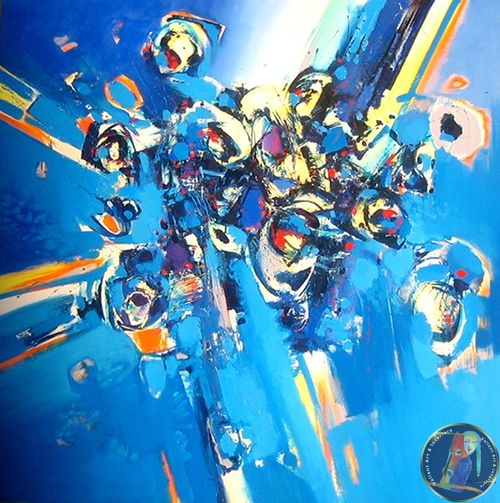
Composition 14 is a commanding oil on canvas work that serves as a bridge between Enkhtaivan Ochirbat’s academic roots in Ulaanbaatar and his evolution into Abstract Expressionism. Measuring a substantial 130 x 130 cm, the square format provides a balanced yet expansive stage for his exploration of the Mongolian landscape through a contemporary lens.
Visual Breakdown
Color Palette and Atmosphere: The work is characterized by a sophisticated interplay of earthy tones and vibrant, emotive strikes. True to his Expressionist style, Ochirbat avoids literal representation. Instead, he uses deep ochres, burnt siennas, and slate greys to evoke the rugged terrain of the Mongolian steppe, punctuated by sudden flashes of light or saturated pigment that suggest the atmospheric shifts of the high-altitude climate.
Brushwork and Texture: Reflecting his experience in the “Art Studio” and his tenure as a teacher, the technique in Composition 14 is highly disciplined yet appears spontaneous. The paint is applied with varied density—ranging from thin, translucent washes that provide depth to heavy impasto strokes that create a physical topography on the canvas. These textures mirror the physical reality of the Mongolian earth, from dusty plains to jagged rock formations.
Composition and Form: As the title suggests, the painting focuses on the “composition” of space rather than a specific subject. While it leans into the Abstract Modern style, there is a lingering Contemporary Figurative influence. Forms emerge and dissolve; what might appear to be a horizon line or the silhouette of a nomadic structure is intentionally blurred, forcing the viewer to engage with the rhythm of the lines rather than a static image.
Cultural and Artistic Context
Created in 2005—a pivotal year that saw Ochirbat exhibiting internationally in Bulgaria, Poland, and South Korea (Jeju)—Composition 14 represents the artist at a point of high creative momentum.
The Mongolian Identity: The painting captures the “spirit of place.” Even in its abstraction, the work conveys the vastness and the “treasure” of the landscape (a theme hinted at in his 2004 US exhibition, Treasure and Horses).
The Teacher’s Eye: As an art teacher at the “Industry and Art” school since 2002, Ochirbat’s work during this period shows a mastery of formal elements—balance, contrast, and scale—while maintaining the raw, emotional energy characteristic of the post-Soviet Mongolian art scene.