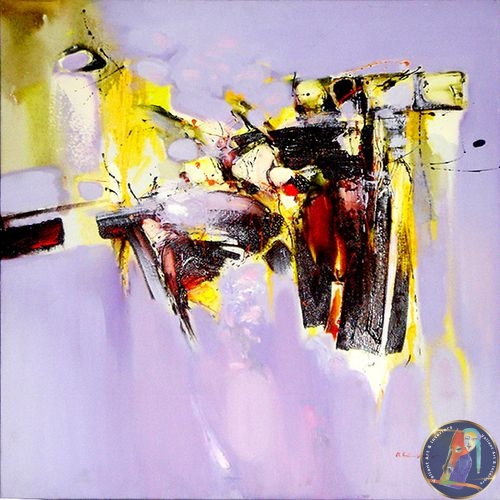
Composition 2

Enkhtaivan Ochirbat , 2005 , Oil On Canvas

Composition 2 is a compelling oil-on-canvas work that serves as a bridge between Enkhtaivan Ochirbat’s traditional Mongolian roots and the sweeping influence of global Abstract Expressionism. Measuring a perfectly balanced 59 x 59cm, the square format provides a stable stage for a visual language that is otherwise fluid, energetic, and deeply atmospheric.

Color Palette and Texture

The painting is defined by a sophisticated interplay of earth tones and atmospheric neutrals. Ochirbat utilizes a range of ochres, deep burnt siennas, and muted umbers that evoke the rugged, sun-drenched landscapes of the Mongolian steppe. These are contrasted against ethereal washes of slate grey and off-white, creating a sense of shifting light or distant mist.

The application of the oil paint is varied and tactile:

  • Impasto accents: Thick, gestural strokes provide physical depth, catching the light and suggesting rocky outcrops or topographical features.

  • Glazing and Scumbling: Thinner layers of paint allow underlying colors to bleed through, creating a luminous, translucent quality that suggests a “Contemporary Figurative Landscape” without being literal.

Form and Structure

True to its title, the work is an exercise in balance and spatial tension. While primarily abstract, the composition hints at the “Contemporary Figurative” style through its structural arrangement.

  • Verticality vs. Horizontality: Strong vertical marks cut through the mid-ground, acting as anchors that ground the more fluid, horizontal sweeps of color. These vertical elements often mimic the presence of man-made structures or solitary figures within a vast expanse.

  • The Horizon Line: There is a subtle, fractured suggestion of a horizon line, which pulls the viewer’s eye across the canvas. However, Ochirbat intentionally disrupts this line with expressive splatters and “action” painting techniques, preventing the work from settling into a traditional landscape.

Emotional Resonance

Reflecting the “Action” exhibition series (2002-2004) that preceded its creation, Composition 2 vibrates with a sense of deliberate movement. It captures the spirit of 2005—a period where Ochirbat was gaining international exposure in Europe and the Americas.

The painting does not seek to depict a specific place, but rather the feeling of a place. It balances the silence and isolation of the Ulaanbaatar outskirts with the kinetic energy of an artist engaged in a physical dialogue with his canvas. The result is a work that feels both ancient, through its use of elemental colors, and fiercely modern in its execution.

Artistic Context

Created while the artist was teaching at the “Industry and Art” school, Composition 2 represents a mature synthesis of his academic training (1993-1998) and his evolving personal philosophy. It stands as a testament to the “Spring” and “Autumn” cycles of the Union of Mongolian Artists, showcasing a shift toward a more subjective, expressionist interpretation of the Mongolian environment.
  • Enkhtaivan Ochirbat
  • Figurative, Geometric, Minimalist
  • Oil On Canvas
  • ENT21/003
  • 59 x 59cm
  • Mongolian Art Gallery

Add Your Comment

Mongolian Art Gallery © 2025. All Rights Reserved
Privacy Policy / Terms of Use

Composition 2 is a compelling oil-on-canvas work that serves as a bridge between Enkhtaivan Ochirbat’s traditional Mongolian roots and the sweeping influence of global Abstract Expressionism. Measuring a perfectly balanced 59 x 59cm, the square format provides a stable stage for a visual language that is otherwise fluid, energetic, and deeply atmospheric.

Color Palette and Texture

The painting is defined by a sophisticated interplay of earth tones and atmospheric neutrals. Ochirbat utilizes a range of ochres, deep burnt siennas, and muted umbers that evoke the rugged, sun-drenched landscapes of the Mongolian steppe. These are contrasted against ethereal washes of slate grey and off-white, creating a sense of shifting light or distant mist.

The application of the oil paint is varied and tactile:

  • Impasto accents: Thick, gestural strokes provide physical depth, catching the light and suggesting rocky outcrops or topographical features.

  • Glazing and Scumbling: Thinner layers of paint allow underlying colors to bleed through, creating a luminous, translucent quality that suggests a “Contemporary Figurative Landscape” without being literal.

Form and Structure

True to its title, the work is an exercise in balance and spatial tension. While primarily abstract, the composition hints at the “Contemporary Figurative” style through its structural arrangement.

  • Verticality vs. Horizontality: Strong vertical marks cut through the mid-ground, acting as anchors that ground the more fluid, horizontal sweeps of color. These vertical elements often mimic the presence of man-made structures or solitary figures within a vast expanse.

  • The Horizon Line: There is a subtle, fractured suggestion of a horizon line, which pulls the viewer’s eye across the canvas. However, Ochirbat intentionally disrupts this line with expressive splatters and “action” painting techniques, preventing the work from settling into a traditional landscape.

Emotional Resonance

Reflecting the “Action” exhibition series (2002-2004) that preceded its creation, Composition 2 vibrates with a sense of deliberate movement. It captures the spirit of 2005—a period where Ochirbat was gaining international exposure in Europe and the Americas.

The painting does not seek to depict a specific place, but rather the feeling of a place. It balances the silence and isolation of the Ulaanbaatar outskirts with the kinetic energy of an artist engaged in a physical dialogue with his canvas. The result is a work that feels both ancient, through its use of elemental colors, and fiercely modern in its execution.

Artistic Context

Created while the artist was teaching at the “Industry and Art” school, Composition 2 represents a mature synthesis of his academic training (1993-1998) and his evolving personal philosophy. It stands as a testament to the “Spring” and “Autumn” cycles of the Union of Mongolian Artists, showcasing a shift toward a more subjective, expressionist interpretation of the Mongolian environment.