
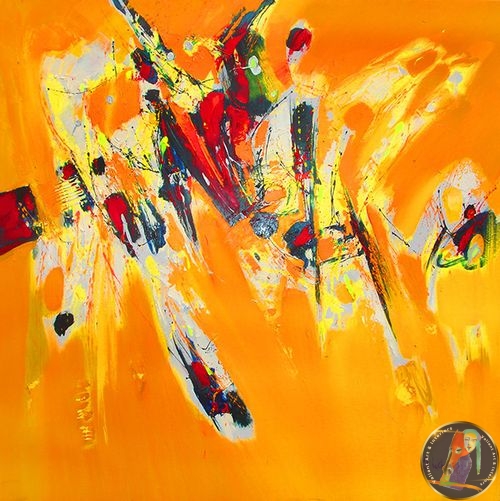
Composition 16 is a compelling oil on canvas work that serves as a bridge between Enkhtaivan Ochirbat’s traditional Mongolian roots and the sweeping gestures of modern abstraction. Measuring 92 x 92 cm, the square format provides a balanced stage for a high-energy, expressive exploration of color and form.
Color Palette and Atmosphere
The painting is dominated by a sophisticated interplay of earth tones and vibrant primaries. Ochirbat utilizes a base of deep ochre, sienna, and muted umber, which anchors the piece in a landscape-like sensibility. These grounded tones are punctuated by sharp, emotive bursts of crimson red, cerulean blue, and stark white. The application of paint suggests a “Contemporary Figurative Landscape” style, where the colors do not necessarily represent specific objects, but rather the shifting light and atmosphere of the Mongolian steppe.
Composition and Technique
The composition is characterized by kinetic energy and thick, impasto textures. Rather than a traditional horizon line, the work features a central “clumping” of forms that suggests movement—perhaps the memory of galloping horses or the shifting of nomadic architecture (Gers).
Brushwork: Large, sweeping palette knife strokes and broad brush marks create a sense of urgency. The paint is layered, with some areas appearing translucent while others are heavily textured, creating physical depth on the canvas.
Abstraction vs. Figuration: While the piece is primarily abstract, there is a rhythmic, “Expressionist” quality to the vertical and diagonal lines that hint at human or animal figures moving through a vast space.
Balance: The square dimensions are utilized to push the energy toward the edges of the frame, giving the viewer the impression that the scene extends far beyond the physical limits of the canvas.
Artistic Context
Created in 2006, during the artist’s tenure as a teacher at the “Industry and Art” school, Composition 16 reflects a mature period of experimentation. Having participated in international exhibitions in Russia, America, and Europe just prior to this work, Ochirbat’s style in this painting shows a global confidence. It moves away from the rigid realism of his early education, embracing the emotional freedom found in his “Action” exhibition series (2002–2004).