
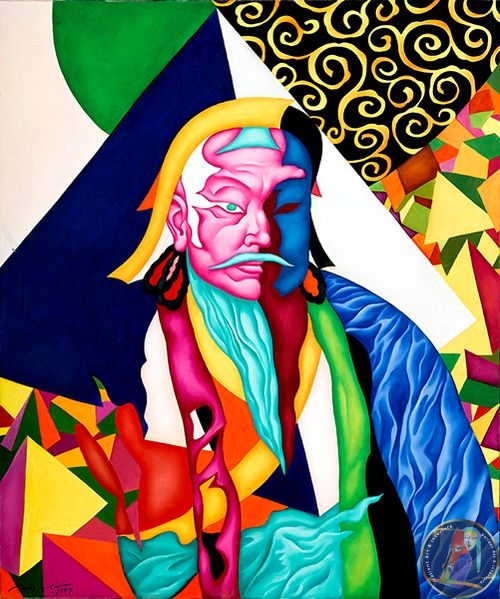
Old Building is a compelling oil on canvas work that measures 99 x 119 cm. Created in 2005, it serves as a bridge between Enkhjargal Tsagaandari’s classical training and her mastery of contemporary figurative abstraction.
Composition and Subject Matter
The painting depicts a weathered structure that feels less like a literal architectural study and more like a vessel for memory. The “Old Building” occupies the central focus, yet its edges soften into the surrounding environment, suggesting a deep integration with the landscape.
As an artist born in Ulaanbaatar and deeply rooted in the Mongolian landscape, Tsagaandari utilizes the building as a symbol of the passage of time. The large scale of the canvas allows for a sense of immersion; the viewer is not just looking at a house, but standing before a silent witness to history.
Style and Technique
While the subject is grounded in reality, the execution leans heavily into Abstract and Modernist styles.
Color Palette: Expect a sophisticated interplay of earthy tones—ochres, deep russets, and weathered greys—contrasted with the ethereal light often found in the Mongolian steppe.
Brushwork: Drawing from her experience in monumental art and teaching at the College of Fine Art, Tsagaandari uses bold, confident strokes. The texture of the oil paint is likely layered, mimicking the crumbling plaster or aged wood of the structure itself.
Atmosphere: There is a distinct “Nature” influence here. The building doesn’t stand against the elements; it seems to be reclaiming its place within them. The light is often diffuse, creating a contemplative, almost melancholic mood.
Contextual Significance
To understand Old Building, one must look at the artist’s trajectory. Having worked across various UMA (Union of Mongolian Artists) branches and the Military Institute, Tsagaandari moved from state-commissioned discipline to the creative freedom of a freelance artist in 2000.
Old Building represents this era of independence. It sheds the rigid requirements of monumental art in favor of a personal, figurative landscape that explores the soul of Mongolian urban and rural transition. It reflects a period where her work gained international eyes, following her exhibitions in Vienna and China, blending a nomadic heritage with a modern, global aesthetic.