
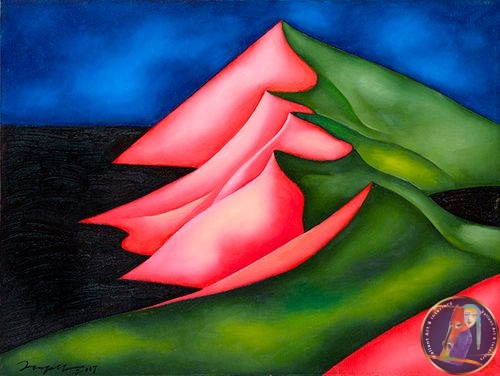
Created in 2007, “Mountain” is a compelling testament to Enkhjargal Tsagaandari’s ability to bridge the gap between traditional Mongolian landscapes and modern abstraction. The work reflects the artist’s deep-rooted connection to the Central Asian topography, interpreted through a lens of contemporary stylistic expression.
Composition and Form
The painting utilizes a 45 x 60 cm horizontal format to capture the expansive majesty of the Mongolian peaks. Tsagaandari employs a figurative-abstract approach, where the physical presence of the mountain is not rendered with photorealistic precision, but rather through a series of rhythmic, structural planes. The forms are bold and architectural, suggesting the rugged, ancient geology of the region while leaning into the artist’s signature Modernist style.
Color Palette and Technique
Working in oil on canvas, the artist likely utilizes a sophisticated interplay of light and shadow to define the mountain’s ridges. Given Tsagaandari’s background in Monumental Art and his experience as a teacher at the College of Fine Art, the brushwork is purposeful and textured. The palette often draws from the natural earth tones of the Uvs aimag or Ulaanbaatar outskirts—ochres, deep indigos, and stark whites—applied in layers that give the canvas a tactile, three-dimensional quality.
Style and Influence
The piece sits at the intersection of Nature and Abstraction. Having spent decades within the Union of Mongolian Artists (UMA), Tsagaandari’s work in “Mountain” moves away from the rigid realism of the mid-20th century, opting instead for a more emotive, spiritual representation of the land. There is a sense of “monumentality” in this small-scale work, likely an influence from his time in the Monumental Art atelier in the late 1980s.
Artist Context
Born in 1960 in Ulaanbaatar, Enkhjargal Tsagaandari is a veteran of the Mongolian contemporary art scene. His career spans the transition of Mongolia from a socialist state to a democracy, a shift reflected in his move from institutional roles (like his time at the Military Institute and the UMA) to becoming a freelance artist in 2000.
His international exposure—ranging from exhibitions in Vienna, Austria to China—informed a style that is uniquely Mongolian yet universally modern. “Mountain” represents a mature period in his career where his technical mastery of oil and his philosophical appreciation for the landscape converge into a singular, powerful vision.