
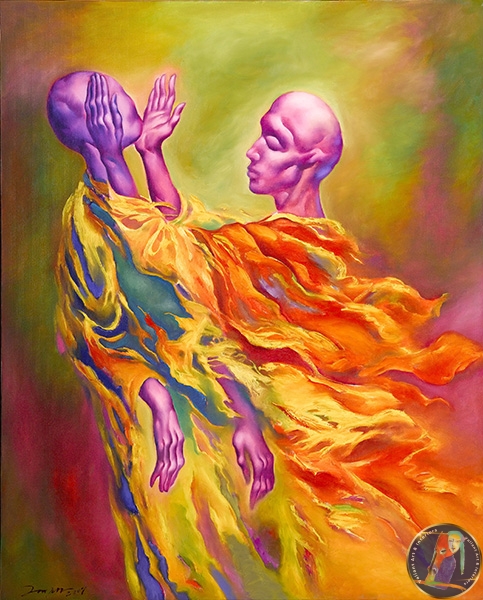
Touch is a compelling oil-on-canvas work that exemplifies Enkhjargal Tsagaandari’s ability to bridge the gap between figurative tradition and contemporary abstraction. Measuring 100 x 80 cm, the piece utilizes its vertical orientation to create a sense of intimate, upward momentum, drawing the viewer into a space that feels both grounded in nature and untethered by reality.
Visual Composition and Style
The painting is characterized by a sophisticated interplay of organic forms and textural depth. Consistent with Tsagaandari’s background in monumental art and his experience as a teacher at the College of Fine Art, the composition exhibits a masterful control of balance.
Color Palette: The work leans into a modern palette, likely employing earthy tones juxtaposed with ethereal highlights. These colors suggest the vast, rugged landscapes of Mongolia, yet they are applied with a modern sensibility that favors mood over literal representation.
Thematic Focus: True to its title, the painting explores the concept of contact—whether physical, spiritual, or environmental. The “touch” may be represented through the soft blending of edges where human-like figures melt into a landscape, or through the tactile quality of the oil paint itself, which the artist often applies with varied thickness to create a “living” surface.
Artistic Context
Created in 2007, during Tsagaandari’s prolific period as a freelance artist, Touch reflects a seasoned maturity. Having moved away from the structured environments of the Military Institute and the UMA (Union of Mongolian Artists) branches, this work demonstrates the freedom of his later style.
Synthesis of Styles: The painting serves as a crossroads for the artist’s diverse influences. It contains the structural integrity of monumental art, the fluidity of nature-inspired abstraction, and the emotional resonance of contemporary figurative work.
Cultural Resonance: While the style is contemporary, there is an inherent nod to the Mongolian “Spring” and the vastness seen in his earlier exhibitions in Ulaanbaatar and Vienna. The work captures a specific sense of identity—the feeling of being connected to a lineage while standing firmly in the present.
Interpretive Summary
In Touch, Tsagaandari moves beyond simple depiction to capture a sensory experience. The 100 x 80 cm frame acts as a window into a moment of connection. It is not merely a landscape or a figure, but the energetic space between things. The viewer is invited not just to look, but to feel the weight, warmth, and texture of the subject matter, making it a quintessential example of modern Mongolian fine art.