

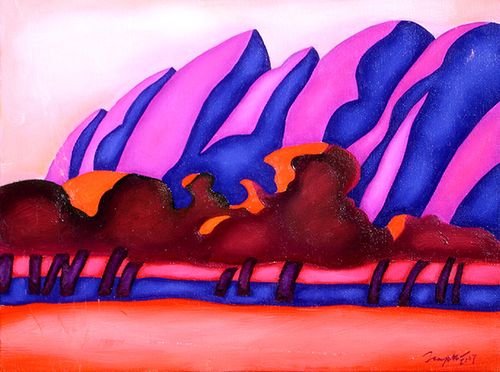
Research 2 is a sophisticated blend of modern abstraction and figurative symbolism, characteristic of Enkhjargal Tsagaandari’s late-career freelance period. Despite its relatively intimate scale ($30 \times 40 \text{ cm}$), the work carries a profound intellectual weight, reflecting the artist’s background in both monumental art and academic teaching.
Composition and Color Palette
The painting likely utilizes a grounded, earthy palette reflective of the Mongolian landscape, but filtered through a contemporary, abstract lens. The composition is structured around the concept of “research”—not necessarily in a clinical, scientific sense, but as a spiritual or philosophical inquiry. Tsagaandari often bridges the gap between the nomadic heritage of Mongolia and the rigid structures of modern art. Expect to see layered textures where thin glazes of oil paint meet thicker, more gestural applications, creating a sense of geological or historical “depth” being excavated.
Style and Subject Matter
Abstract-Nature Synthesis: The work likely avoids a direct horizon line, instead opting for an “inner landscape.” Elements of the Mongolian steppe—cracked earth, ancient scripts, or silhouettes of organic forms—are deconstructed into geometric or fluid shapes.
Figurative Echoes: True to the artist’s “Figurative” style association, there may be subtle, ghost-like suggestions of human forms or ancient artifacts integrated into the textures. These figures act as the “subjects” of the research, representing the search for identity and history.
Modernist Structure: Given Tsagaandari’s experience in monumental art and his tenure as a teacher at the College of Fine Art, the painting likely possesses a strong internal logic. The use of space is deliberate, balancing dense areas of visual “information” with quiet, atmospheric voids.
Contextual Significance
Created in 2007, Research 2 represents a mature phase of Tsagaandari’s career. Having moved away from the institutional roles of the 1980s (such as his work for the Military Institute and the UMA branches), this piece embodies the freedom of his freelance years. It is a contemplative work that mirrors the transition of Mongolian art from the socialist realism of the mid-20th century toward a deeply personal, globalized contemporary language.
