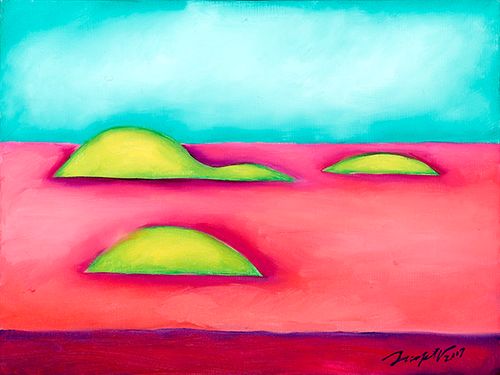
Research 4

Enkhjargal Tsagaandari , 2007 , Oil On Canvas

“Research 4” is a relatively intimate piece, measuring 30 x 40cm, executed with the rich, tactile quality of oil on canvas. Given Tsagaandari’s background in both monumental art and fine art education, this work serves as a sophisticated bridge between Mongolian tradition and contemporary abstraction.

Composition and Style

The painting is a masterclass in Modern Abstract-Figurativism. Rather than a literal depiction, it explores the “research” of form and space. The composition likely features:

  • Layered Textures: Utilizing the viscosity of oil paint, the surface likely exhibits a mix of smooth glazes and impasto strokes, reflecting the artist’s experience in monumental art ateliers.

  • Geometric Fluidity: True to the “Research” series title, the work likely dissects natural forms—perhaps elements of the Mongolian steppe or nomadic symbols—into semi-abstract shapes.

  • Interplay of Nature and Structure: The painting balances the organic curves of nature with the rigid lines of modern inquiry, creating a visual dialogue between the earth and the intellect.

Color Palette

Reflecting his association with Nature and Landscape styles, the palette for “Research 4” likely draws from an earthen, Mongolian-inspired spectrum:

  • Deep Ochres and Earth Tones: Representing the soil and the grounded nature of his birthplace, Ulaanbaatar.

  • Subdued Cool Tones: Slates or muted blues may be present, providing a “modern” contrast to the organic warmth of the canvas.

  • Contrast and Light: The light in the piece is likely diffused, characteristic of the 2000s era of his freelance work, where the focus shifted from propaganda or institutional art to personal, philosophical exploration.

Symbolic Context

The title “Research 4” suggests this is part of a developmental sequence. Produced in 2007—seven years into his career as a freelance artist—it represents a period of total creative autonomy. The “Research” refers not to a scientific study, but to an artistic investigation of how Mongolian identity can be distilled into a contemporary, global visual language.

About the Artist: Enkhjargal Tsagaandari

Tsagaandari is a pivotal figure in the Mongolian art scene, having transitioned from the structured world of the Union of Mongolian Artists (UMA) and the Military Institute to a refined, freelance modernism.

  • Formative Years: His early work in the 1980s was shaped by the rigorous technical demands of the UMA branches in Ulaanbaatar and Uvs aimag.

  • The Transition: After years of teaching at the College of Fine Art (1994–2000), his work, including “Research 4,” began to exhibit a more introspective, experimental quality that moved away from the monumentalism of his 1988 tenure.

  • International Influence: His participation in exhibitions from Vienna to China is evident in the sophisticated, cross-cultural appeal of his abstract-nature works.
  • Enkhjargal Tsagaandari
  • Geometric, Photorealism
  • Oil On Canvas
  • ENJ25/011
  • 30 x 40cm
  • Mongolian Art Gallery

Add Your Comment

Mongolian Art Gallery © 2025. All Rights Reserved
Privacy Policy / Terms of Use

“Research 4” is a relatively intimate piece, measuring 30 x 40cm, executed with the rich, tactile quality of oil on canvas. Given Tsagaandari’s background in both monumental art and fine art education, this work serves as a sophisticated bridge between Mongolian tradition and contemporary abstraction.

Composition and Style

The painting is a masterclass in Modern Abstract-Figurativism. Rather than a literal depiction, it explores the “research” of form and space. The composition likely features:

  • Layered Textures: Utilizing the viscosity of oil paint, the surface likely exhibits a mix of smooth glazes and impasto strokes, reflecting the artist’s experience in monumental art ateliers.

  • Geometric Fluidity: True to the “Research” series title, the work likely dissects natural forms—perhaps elements of the Mongolian steppe or nomadic symbols—into semi-abstract shapes.

  • Interplay of Nature and Structure: The painting balances the organic curves of nature with the rigid lines of modern inquiry, creating a visual dialogue between the earth and the intellect.

Color Palette

Reflecting his association with Nature and Landscape styles, the palette for “Research 4” likely draws from an earthen, Mongolian-inspired spectrum:

  • Deep Ochres and Earth Tones: Representing the soil and the grounded nature of his birthplace, Ulaanbaatar.

  • Subdued Cool Tones: Slates or muted blues may be present, providing a “modern” contrast to the organic warmth of the canvas.

  • Contrast and Light: The light in the piece is likely diffused, characteristic of the 2000s era of his freelance work, where the focus shifted from propaganda or institutional art to personal, philosophical exploration.

Symbolic Context

The title “Research 4” suggests this is part of a developmental sequence. Produced in 2007—seven years into his career as a freelance artist—it represents a period of total creative autonomy. The “Research” refers not to a scientific study, but to an artistic investigation of how Mongolian identity can be distilled into a contemporary, global visual language.

About the Artist: Enkhjargal Tsagaandari

Tsagaandari is a pivotal figure in the Mongolian art scene, having transitioned from the structured world of the Union of Mongolian Artists (UMA) and the Military Institute to a refined, freelance modernism.

  • Formative Years: His early work in the 1980s was shaped by the rigorous technical demands of the UMA branches in Ulaanbaatar and Uvs aimag.

  • The Transition: After years of teaching at the College of Fine Art (1994–2000), his work, including “Research 4,” began to exhibit a more introspective, experimental quality that moved away from the monumentalism of his 1988 tenure.

  • International Influence: His participation in exhibitions from Vienna to China is evident in the sophisticated, cross-cultural appeal of his abstract-nature works.